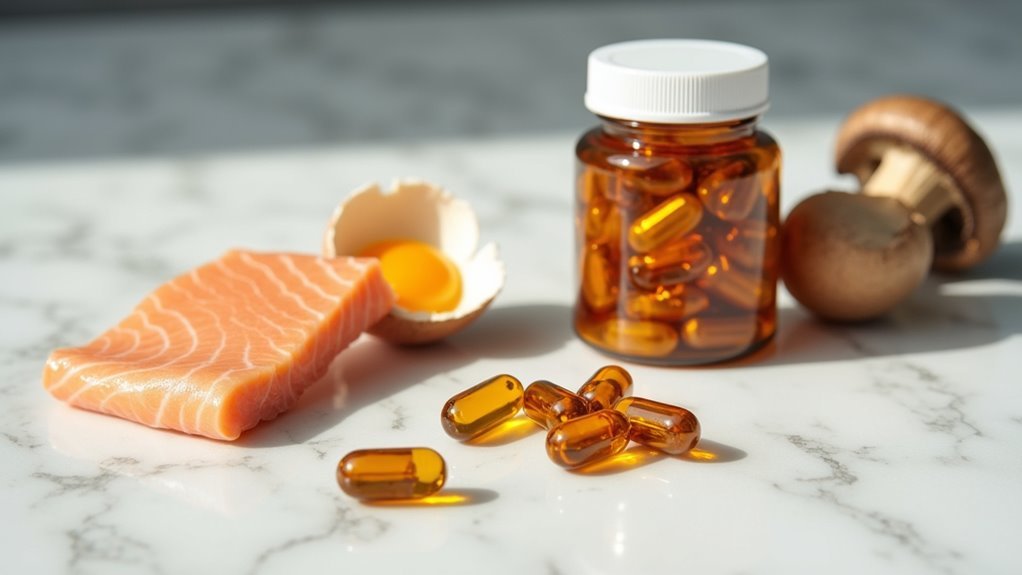
You’ll find vitamin D supplements more reliable than food sources because most natural foods don’t contain enough to meet your 600-800 IU daily needs. Supplements deliver precise, consistent dosing at just $0.10-$0.30 per serving, while fortified foods offer unpredictable amounts and may trigger digestive issues from lactose or gluten. They’re especially valuable if you have dietary restrictions, live above 37 degrees latitude, or experience limited sun exposure. Discover how proper supplementation transforms your vitamin D strategy.
Understanding Vitamin D Deficiency Risks

While vitamin D deficiency affects millions worldwide, you mightn’t realize how serious the consequences can be for your health. When your serum levels drop below 30 ng/mL, you’re facing significant health issues that extend far beyond bone problems.
Your body can’t properly absorb calcium without adequate vitamin D, forcing it to steal calcium from your bones and increasing fracture risk.
Without sufficient vitamin D, your body becomes a calcium thief, robbing your own bones to meet essential needs.
You’re at higher risk if you’re an older adult, have darker skin, or live in northern climates where sun exposure is limited. Food sources alone often can’t provide enough vitamin D to maintain ideal levels.
This deficiency doesn’t just affect your bones—it compromises your immune health and may increase your risk of cognitive decline, autoimmune diseases, and certain cancers.
Convenience and Consistency of Daily Intake
When you’re struggling to maintain adequate vitamin D levels through food alone, supplements offer an unmatched level of convenience and reliability.
Vitamin D supplements provide a consistent source that eliminates guesswork from your daily intake, delivering exactly 600 IU for ages 1-70 or 800 IU for those over 70.
Unlike fortified foods that vary greatly in content, supplements simplify tracking intake and remove dependency on dietary fluctuations. You won’t need to worry about seasonal changes affecting your nutrition or whether you’ve consumed enough vitamin D-rich foods throughout the day.
This consistency becomes especially valuable if you follow restrictive diets or have food intolerances.
Establishing a daily supplement routine enhances adherence to recommended levels, ultimately leading to better health outcomes than relying on unpredictable dietary sources alone.
Enhanced Absorption With Controlled Dosing

Since vitamin D is fat-soluble, supplements offer a strategic advantage in enhanced absorption when you take them with meals containing dietary fat. Research shows you’ll absorb approximately 32% more vitamin D compared to taking supplements on an empty stomach.
Taking vitamin D supplements with fat-containing meals boosts absorption by 32% compared to empty stomach consumption.
This controlled dosing approach lets you precisely adjust your intake to meet individual requirements and achieve ideal blood levels of vitamin D more efficiently.
Unlike inconsistent food sources, vitamin D supplements deliver exact concentrations that help you reach your recommended daily intake reliably. You can quickly correct deficiencies and maintain sufficient vitamin D levels, especially if you live in areas with limited sunlight.
This precision proves particularly valuable for populations with dietary restrictions who struggle to obtain adequate amounts through food alone.
Overcoming Dietary Restrictions and Food Allergies
If you’re managing dietary restrictions or food allergies, vitamin D supplements provide essential flexibility that food sources simply can’t match.
When you have lactose intolerance, you’ll struggle to get adequate vitamin D from dairy products. As a vegan or vegetarian, you’ll find limited access to vitamin D3 from animal sources, making plant-derived supplements essential. Food allergies to fish or eggs further restrict your dietary options for natural vitamin D.
Fortified foods won’t always accommodate your specific dietary needs or allergies. If you have medical conditions like inflammatory bowel disease, your nutrient absorption from food becomes impaired.
Vitamin D supplements bypass these challenges, ensuring you meet your daily requirements regardless of dietary limitations or health conditions affecting nutrient absorption.
Addressing Limited Sun Exposure Challenges

If you’re living above 37 degrees latitude or working indoors most days, you’re likely not getting enough UVB rays to produce adequate vitamin D naturally.
Your geographic location becomes particularly challenging during winter months when the sun’s angle drastically reduces vitamin D synthesis, even with outdoor exposure.
These seasonal and location-based limitations make it nearly impossible to rely solely on sunlight for your vitamin D needs throughout the year.
Geographic Location Limitations
When you’re living above 37 degrees north latitude, your body faces a significant challenge in producing adequate vitamin D during winter months due to limited UVB exposure from sunlight. These geographic limitations make it nearly impossible to maintain ideal levels through natural sunlight exposure alone.
| Geographic Challenge | Impact on Vitamin D |
|---|---|
| High air pollution | Blocks UVB rays effectiveness |
| Frequent cloud cover | Reduces sunlight exposure |
| Long winter seasons | Limits year-round synthesis |
| Northern latitudes | Insufficient UVB intensity |
| Peak hour constraints | Impractical daily exposure |
Vitamin D from food sources can’t compensate for these deficiencies. Vitamin D supplements become essential for preventing vitamin D deficiency and supporting your health and wellness when geographic factors limit natural production.
Seasonal Sunlight Deficiency
How does your body maintain adequate vitamin D levels when winter darkness settles in for months?
Seasonal sunlight deficiency creates a significant challenge for anyone living above 37 degrees north latitude. During winter months, you’ll experience drastically reduced UVB exposure, making natural vitamin D synthesis nearly impossible.
Your vitamin D levels can drop dangerously low during this period, potentially compromising your immune system and leading to serious health issues like weakened bones and increased fracture risk.
Limited sun exposure combined with indoor lifestyles makes vitamin D supplementation essential. You’d need 15-20 minutes of direct sunlight from May to September, which becomes impossible during darker months.
Relying solely on dietary sources won’t provide adequate vitamin D when seasonal sunlight deficiency strikes, making supplements your most practical solution.
Meeting Higher Requirements for At-Risk Groups
If you’re over 70, have limited sun exposure, or belong to other at-risk groups, you’ll need considerably more vitamin D than the average person can easily get from food alone.
Your body requires 800 IU daily after age 70, and certain medical conditions can further impair how well you absorb vitamin D from dietary sources.
Supplements become essential because they can deliver these higher doses more reliably while offering enhanced absorption compared to trying to meet your needs through food alone.
Older Adults Need More
Most older adults face a significant challenge when it comes to maintaining adequate vitamin D levels, requiring higher daily intake recommendations of 800 IU (20 mcg) to support bone health and prevent fractures.
As you age, your body’s ability to synthesize vitamin D decreases considerably, making deficiency more likely.
Several factors make supplementation vital for older adults:
- Your skin produces less vitamin D from sunlight exposure
- Kidney function often declines, impairing vitamin D metabolism
- Dietary restrictions limit access to vitamin D-rich food sources
- Reduced appetite decreases overall nutritional intake
- Osteoporosis risk increases without adequate levels
You’ll find it nearly impossible to meet these higher requirements through food sources alone.
Regular monitoring and targeted supplementation become essential strategies for maintaining healthy bones and preventing cognitive decline in your golden years.
Limited Sun Exposure
Beyond age-related factors, your geographic location and lifestyle choices can drastically limit your body’s natural vitamin D production.
If you live above 37 degrees north latitude or experience limited sun exposure during winter months, you’re at significant risk for vitamin D deficiency. You’d need 15-20 minutes of sun exposure from May to September for adequate synthesis, which isn’t always feasible.
At-risk groups include those with darker skin, homebound individuals, and people wearing sun-blocking clothing.
While dietary sources like fatty fish exist, they rarely provide the recommended daily intake of 600-800 IU for adults.
Vitamin D supplements offer a reliable solution when sun exposure and food sources fall short of meeting your body’s requirements.
Absorption Enhancement Benefits
When you’re part of an at-risk group requiring higher vitamin D levels, supplements offer distinct absorption enhancement advantages that food sources can’t match.
Taking vitamin D supplements with dietary fat can boost your blood levels by up to 50% within 2-3 months, ensuring you meet your daily intake requirements more effectively.
Key benefits for at-risk groups include:
- Reliable dosing – Consistent 800 IU delivery without dietary guesswork
- Enhanced bioavailability – Fat-soluble vitamin absorption maximized with meals
- Convenience factor – No need to consume large quantities of fortified foods
- Malabsorption solution – Bypasses digestive issues that limit food-based absorption
- Year-round consistency – Maintains ideal levels regardless of seasonal dietary changes
This approach supports your bone health and overall well-being when traditional food sources prove insufficient.
Year-Round Availability Despite Seasonal Changes
Although your body’s ability to produce vitamin D from sunlight drops dramatically during winter months—especially if you live above 37 degrees north latitude—supplements provide a reliable solution that doesn’t depend on weather or seasonal changes.
You can’t always count on dietary sources like oily fish or fortified foods to meet your needs consistently throughout the year.
Vitamin D supplements offer year-round availability, ensuring you maintain adequate levels regardless of season.
This becomes particularly essential if you have darker skin tones, as your natural vitamin D production is less efficient even during sunny periods.
Supplementation guarantees you’ll meet the recommended daily intake of 10 micrograms (400 IU) when sun exposure isn’t possible and dietary sources fall short.
Cost-Effectiveness Compared to Fortified Foods
While fortified foods might seem like a natural choice for boosting your vitamin D intake, supplements often deliver better value for your money. The cost-effectiveness of vitamin D supplements becomes clear when you compare daily dosage expenses and long-term nutritional goals.
Consider these financial advantages of supplements over fortified foods:
- A 1000 IU vitamin D supplement costs only $0.10-$0.30 per serving
- Fortified foods require higher expenditures to achieve equivalent vitamin D levels
- Supplements provide consistent, measurable dosages unlike variable fortified food content
- You’ll avoid purchasing multiple expensive fortified products to meet recommended intake
- They’re more accessible for people with dietary restrictions
Supplements offer a reliable source that effectively reduces your risk of deficiency while keeping costs manageable year-round.
Precise Dosage Control for Therapeutic Needs
If you’re managing a vitamin D deficiency or specific health condition, supplements deliver the precise dosage control that food sources simply can’t match.
You’ll get exactly 800 IU if you’re over 70 or 600 IU for ages 1-70, meeting your recommended daily intake consistently. Unlike foods where vitamin D content varies dramatically, vitamin D supplements provide reliable intake every time you take them.
Your healthcare provider can easily adjust dosages based on your blood test results, targeting specific therapeutic levels for your unique needs.
If you have liver or kidney disease affecting vitamin D metabolism, supplements offer targeted treatment.
When your dietary intake falls short due to limited sun exposure or food restrictions, supplements guarantee you’ll meet therapeutic requirements effectively without guesswork.
Avoiding Food-Related Digestive Issues
When lactose intolerance, celiac disease, or other digestive conditions limit your food choices, vitamin D supplements offer a digestive-friendly alternative that won’t trigger uncomfortable symptoms.
Food intolerances can make meeting your vitamin D needs through diet particularly challenging. Consider these advantages of supplementation:
- Bypass lactose intolerance – Skip fortified dairy products that cause gastrointestinal distress.
- Avoid gluten complications – Eliminate concerns about fortified cereals and processed foods.
- Overcome absorption issues – Bypass digestive challenges from inflammatory bowel disease or celiac disease.
- Support restrictive diets – Guarantee adequate intake when vegan or vegetarian options fall short.
- Eliminate digestive discomfort – Remove uncertainty about which foods might trigger symptoms.
Supplements allow you to absorb nutrients without traversing complex dietary restrictions, providing reliable vitamin D intake regardless of your digestive limitations.
Long-Term Storage and Shelf Stability Benefits
Beyond digestive comfort, vitamin D supplements offer considerable practical advantages in storage and longevity that food sources simply can’t match.
When you store Vitamin D supplements properly in cool, dry places, they maintain potency for 1-2 years, ensuring reliable dosing whenever you need it. Unlike food sources that lose nutrients through oxidation and spoilage, supplements retain their effectiveness throughout their shelf life.
This exceptional shelf stability means you’ll maintain adequate levels without worrying about spoiled ingredients.
Since vitamin D is a fat-soluble vitamin, supplement formulations enhance both absorption and long-term storage capabilities. You’ll achieve controlled intake with precise dosages that remain consistent over time, unlike dietary sources where vitamin D content varies considerably based on preparation methods and storage conditions.
Frequently Asked Questions
Is It Better to Get Vitamin D From Food or Supplements?
You’ll likely need supplements since you can’t get enough vitamin D from food alone. Supplements provide consistent, controlled doses of vitamin D3, which works better than food sources for maintaining adequate levels.
What Is the Best Way to Take Vitamin D for Absorption?
You’ll absorb vitamin D best when taking it with your largest meal containing dietary fat. Take it consistently at the same time daily, whether breakfast or dinner, to maximize absorption and establish a routine.
Is There Any Point in Taking Vitamin D Supplements?
You’ll benefit from vitamin D supplements if you can’t get enough sunlight or have limited dietary sources. They’re especially important during winter months and can effectively boost your blood levels to prevent deficiency.
What Is the Best Form of Vitamin D to Take?
You should choose vitamin D3 supplements over D2 because they’re more effective at raising your blood levels. D3 has better absorption and lasts longer in your system than D2.


Leave a Reply