
You’ll preserve the most vitamin D by using gentle cooking methods like sous-vide, which retains up to 135% of vitamin D content, or steaming and microwaving eggs for 109% retention. Avoid high-heat techniques like deep-frying and boiling, as they greatly reduce vitamin D levels. Pan-frying works better than deep-frying, while poached eggs maintain 93% of their vitamin D. The key is controlling temperature and minimizing cooking time to protect these fat-soluble nutrients from degradation and discover ideal techniques for each food type.
The Science Behind Vitamin D Stability During Heat Exposure
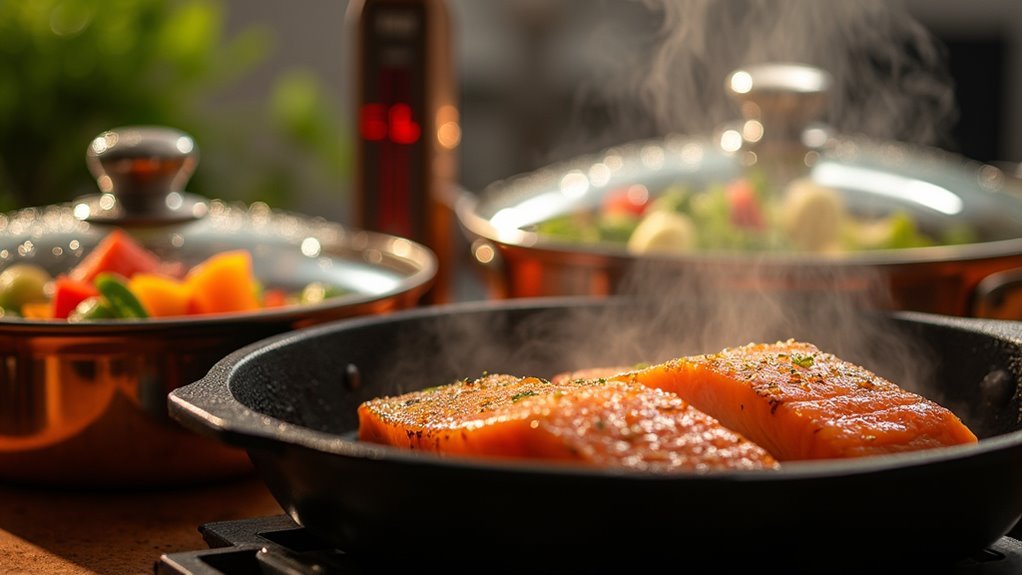
When you cook vitamin D-rich foods, the nutrient’s stability depends heavily on the cooking method and temperature you choose.
Heat exposure affects vitamin D differently across various techniques, with some cooking methods to preserve this essential nutrient proving more effective than others.
Research reveals that vitamin D retention varies dramatically based on your chosen approach. You’ll find that scrambled and microwaved eggs actually retain up to 109% of their vitamin D content, while poached eggs maintain 93%.
However, harder cooking methods show declining results—hard-boiled eggs retain only 80%, and fried eggs drop to 78%.
Temperature control plays a significant role in preservation. Sous-vide cooking demonstrates superior vitamin D retention at 135°F, suggesting that gentler heat exposure protects this critical nutrient better than high-temperature methods.
Sous-Vide Cooking: The Champion of Vitamin D Retention
You’ll find that sous-vide cooking’s precise temperature control creates the ideal environment for vitamin D preservation, achieving up to 135% retention compared to raw pork.
The vacuum-sealed environment eliminates oxygen exposure while maintaining consistent low temperatures, preventing the nutrient degradation that occurs with traditional high-heat methods.
This controlled cooking science explains why sous-vide consistently outperforms pan-frying, roasting, and grilling in preserving your food’s vitamin D content.
Sous-Vide Temperature Benefits
Although traditional cooking methods often diminish vitamin D content, sous-vide stands as the undisputed champion for preserving this essential nutrient.
You’ll achieve remarkable vitamin D retention through sous-vide’s precise temperature control, which operates at lower temperatures than conventional cooking methods. This gentle approach prevents the breakdown of fat-soluble vitamin D metabolites that typically occurs with high-heat cooking.
When you cook pork using sous-vide, you’re actually increasing vitamin D levels by 49% compared to raw pork, while boosting 25(OH)D by 33%.
The vacuum-sealed environment combined with controlled low temperatures creates ideal conditions for nutrient preservation. You’ll maintain 100% total vitamin D activity retention in your cooked products, making sous-vide the superior choice for maximizing this essential nutrient’s bioavailability.
Vacuum Cooking Science
The science behind vacuum cooking reveals why sous-vide delivers such exceptional vitamin D preservation results.
When you vacuum-seal pork before cooking, you’re creating an oxygen-free environment that prevents vitamin degradation. Unlike traditional cooking methods that expose food to air and fluctuating temperatures, sous-vide cooking maintains precise thermal control while eliminating oxidative stress on nutrients.
You’ll achieve remarkable vitamin D retention because the vacuum environment protects delicate compounds from breaking down. The controlled temperature prevents the harsh conditions that typically destroy vitamins in conventional cooking.
Research shows you can increase vitamin D content by 49% through this method, with some samples showing 135% retention compared to raw pork. This superior preservation occurs because vacuum cooking minimizes nutrient losses while enhancing bioavailability.
Pan-Frying vs. Deep-Frying: Which Method Wins for Nutrient Preservation
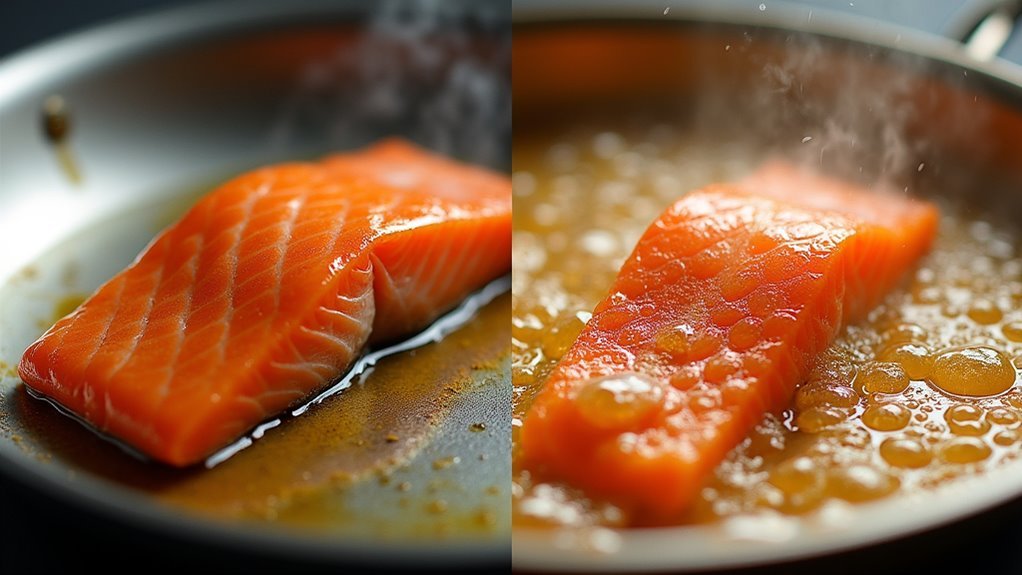
When you’re choosing between pan-frying and deep-frying, you’ll find that heat exposure creates the biggest difference in vitamin D preservation.
Pan-frying’s lower oil temperatures and shorter cooking times work in your favor, while deep-frying’s intense heat and prolonged exposure can destroy those valuable nutrients.
You’ll want to understand how these temperature and timing factors directly impact your food’s nutritional value.
Heat Exposure Differences
Since vitamin D degrades under excessive heat, your choice between pan-frying and deep-frying can greatly impact how much of this essential nutrient survives the cooking process.
Pan-frying exposes your food to moderate temperatures for shorter periods, creating ideal conditions for vitamin D retention. This controlled heat exposure allows you to preserve up to 100% of vitamin D activity in certain foods.
Deep-frying subjects your ingredients to intense heat for extended durations, creating harsh conditions that break down sensitive vitamins.
These cooking methods differ markedly in their heat exposure patterns, directly affecting nutrient preservation. When you choose pan-frying over deep-frying, you’re not only maximizing vitamin D retention but also avoiding the formation of harmful compounds that develop during high-temperature cooking.
Oil Temperature Impact
Oil temperature serves as the primary factor determining whether you’ll preserve or destroy vitamin D during cooking. Pan-frying operates at moderate temperatures, allowing you to maintain more vitamin D compared to deep-frying’s intense heat. When you choose cooking methods with controlled oil temperature, you’re protecting sensitive nutrients from degradation.
| Factor | Pan-Frying | Deep-Frying |
|---|---|---|
| Oil Temperature | Moderate (300-350°F) | High (350-400°F+) |
| Vitamin D Retention | Higher preservation | Significant loss |
| Temperature Control | Better monitoring | Rapid heat increase |
| Nutrient Stability | Enhanced protection | Compromised integrity |
You’ll achieve better nutrient preservation by monitoring your oil temperature carefully. Excessive heat compromises vitamin D stability, while moderate temperatures during pan-frying help you create healthier meals with superior nutritional value.
Cooking Time Effects
Although temperature matters considerably, cooking time creates an equally vital impact on vitamin D preservation during frying methods.
When you pan-fry foods, you’ll typically use shorter cooking times that help maintain vitamin D levels more effectively than extended deep-frying sessions. These shorter exposure periods mean less opportunity for nutrient loss to occur.
Deep-frying requires longer cooking times due to thicker oil layers and higher volumes, which increases your food’s exposure to heat degradation.
You’ll find that cooking methods with prolonged heat exposure can destroy vitamin D molecules more readily. Pan-frying’s quick cooking approach allows you to achieve proper doneness while maximizing vitamin D retention.
Studies show that minimizing cooking duration directly correlates with better nutrient preservation, making time management vital for maintaining your food’s nutritional value.
Boiling and Simmering: Water-Based Methods and Vitamin D Loss
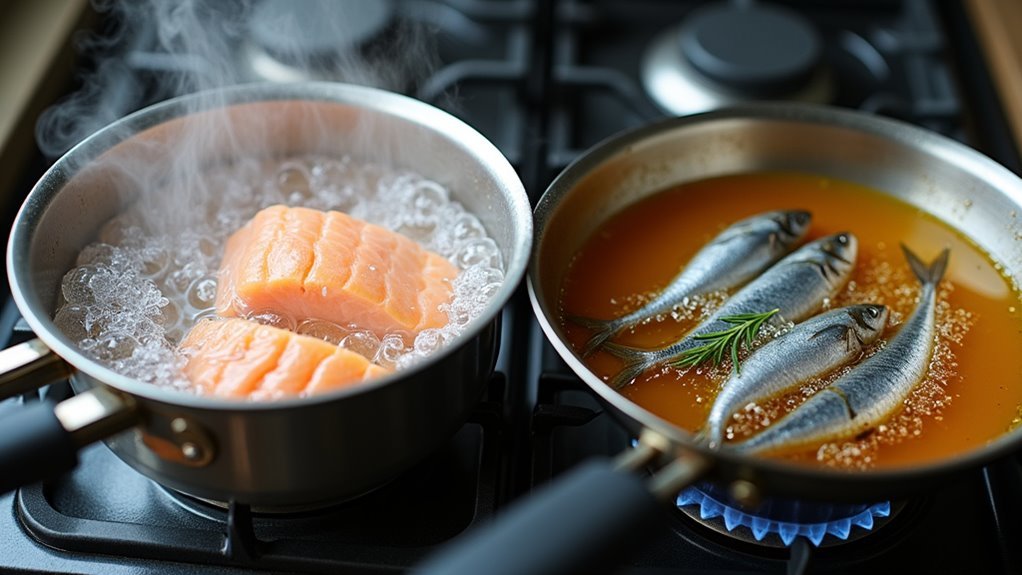
When you boil or simmer vitamin D-rich foods, you’re likely losing a significant portion of this essential nutrient. Boiling causes vitamin D to leach into the cooking water, making it less available for your body.
Simmering presents similar challenges, with studies showing up to 60% of B vitamins lost during meat preparation, indicating comparable vitamin D loss risks.
Water-based cooking methods aren’t ideal for preserving fat-soluble vitamins like vitamin D compared to dry heat alternatives.
However, you can salvage some nutrition by consuming the cooking liquid, which retains 100% of minerals and 70-90% of B vitamins.
To minimize vitamin D loss while boiling or simmering, use minimal water and reduce cooking times whenever possible.
Grilling and Roasting: High-Heat Impact on Vitamin D Content
While grilling and roasting create delicious flavors through high-heat cooking, they produce mixed results for vitamin D retention in your food. These cooking methods can actually enhance vitamin D content in certain meats—cooked pork retains 100% of its vitamin D activity compared to raw. However, prolonged exposure to intense temperatures will degrade vitamin D levels, making timing essential.
| Cooking Method | Vitamin D Retention | Heat Level | Time Sensitivity |
|---|---|---|---|
| Grilling | Variable (depends on duration) | Very High | High |
| Roasting | Moderate to High | High | Moderate |
| Sous-vide | Up to 135% | Low | Low |
| Raw | Baseline 100% | None | N/A |
You’ll need to monitor cooking times carefully when grilling and roasting to maximize vitamin D retention while achieving desired flavors.
Steaming: A Gentle Approach to Maintaining Nutrients
Since steaming relies on gentle, moist heat rather than intense direct temperatures, it’s become one of the most effective methods for preserving vitamin D in your food. This cooking technique uses minimal water and moderate temperatures, protecting water-soluble vitamins that you’d typically lose through boiling or frying.
When you steam your food, you’re avoiding direct water contact, which markedly improves nutrient retention rates.
You’ll find steaming particularly beneficial for delicate foods like fish and leafy greens—both excellent vitamin D sources. Research shows that steaming vegetables results in higher vitamin retention compared to harsher cooking methods.
Your steamed foods won’t just maintain their nutritional value; they’ll also keep their original flavor and texture, making them more appealing while delivering maximum nutrients.
Microwave Cooking: Speed vs. Vitamin D Preservation
How effective is your microwave at preserving vitamin D compared to traditional cooking methods?
You’ll be pleased to know that microwave cooking achieves an impressive 109% vitamin D retention rate in eggs, matching scrambled eggs prepared the same way. This quick cooking method considerably reduces nutrient loss compared to longer techniques, making it your best bet for maximizing vitamin D preservation.
When you microwave eggs, you’re retaining more vitamin D than frying, which only preserves 78%. The speed advantage works in your favor—shorter cooking times mean fewer nutrients escape.
Additionally, microwave cooking minimizes water usage, helping preserve water-soluble vitamins alongside vitamin D. If you’re looking to boost your dietary vitamin D intake without compromising nutrient quality, microwaving offers an efficient solution.
Raw vs. Cooked Foods: When Cooking Actually Increases Vitamin D
You’ll find that cooking certain foods actually boosts their vitamin D content rather than depleting it, defying the common belief that raw foods are always more nutritious.
Heat breaks down cellular structures and releases bound nutrients, making vitamin D more accessible to your body during digestion.
This processing effect transforms how your digestive system can absorb and utilize the vitamin D that’s naturally present in foods like pork and eggs.
Cooking Enhances Bioavailability
Contrary to popular belief, cooking certain vitamin D-rich foods actually increases their nutritional value rather than diminishing it.
When you cook vitamin D-containing foods properly, you’re actually enhancing bioavailability and retention rates considerably.
Research demonstrates remarkable improvements in vitamin D content through specific cooking methods:
- Scrambled and microwaved eggs achieve 109% vitamin D retention compared to raw eggs.
- Sous-vide techniques yield the highest retention at 135% of original content.
- Cooked pork products show a 49% increase in vitamin D levels versus raw pork.
You’ll maximize vitamin D benefits by choosing ideal cooking techniques.
Fried eggs retain up to 84% of their content, while poached eggs maintain 93%.
These findings challenge conventional wisdom about cooking destroying nutrients, proving that proper preparation actually enhances vitamin D availability.
Heat Releases Nutrients
Although many people assume that cooking destroys nutrients, heat actually liberates vitamin D from its bound forms in certain foods, making it more accessible for your body to absorb.
Research demonstrates that cooking methods can dramatically increase vitamin D availability – pork shows a 49% increase in vitamin D levels when cooked compared to raw. This transformation occurs because heat breaks down cellular structures that bind nutrients, releasing them for easier absorption.
You’ll achieve ideal vitamin D retention by choosing the right techniques. Sous-vide cooking delivers exceptional results, with some samples showing 135% retention rates.
For eggs, scrambling and microwaving preserve up to 109% of vitamin D content, while poaching retains 93%. These findings prove that strategic cooking methods enhance rather than diminish nutritional value.
Processing Improves Absorption
When comparing raw versus cooked foods, processing consistently demonstrates superior vitamin D absorption rates across multiple food categories.
You’ll find that cooked eggs can retain up to 109% of their vitamin D content through scrambling and microwaving, effectively enhancing nutrient bioavailability.
Pork products show even more dramatic improvements, with cooking increasing total vitamin D levels by 49% compared to raw meat.
The best cooking methods for maximum vitamin D retention include:
- Sous-vide cooking – achieves 135% vitamin D retention in pork products
- Scrambling and microwaving – maintains 109% of vitamin D in eggs
- Poaching – preserves 93% of egg vitamin D content
These processing techniques break down cellular structures, making vitamin D more accessible for absorption while maintaining nutritional integrity.
Temperature and Time: Finding the Sweet Spot for Maximum Retention
Since vitamin D breaks down under excessive heat exposure, you’ll need to balance temperature and time to preserve this essential nutrient.
Research shows that cooking methods using lower temperatures and shorter durations consistently achieve better vitamin D retention rates. You can maximize nutrient preservation by selecting gentle techniques like sous-vide cooking, which reaches retention rates up to 135% in pork products.
When preparing eggs, you’ll find that microwaved and scrambled preparations retain 109% of vitamin D content, outperforming frying and boiling methods.
The key lies in minimizing prolonged heat exposure while ensuring food safety. By understanding the relationship between temperature and time, you’ll optimize your cooking approach to maintain maximum vitamin D levels in your meals.
Food-Specific Guidelines: Optimal Methods for Eggs, Fish, and Meat
How can you tailor your cooking approach to preserve vitamin D in specific foods? Different foods require distinct cooking methods to maximize nutrient retention.
For eggs, scrambling and microwaving delivers exceptional results, achieving 109% vitamin D retention. Poaching follows closely at 93%, while hard-boiling and frying show lower retention rates at 80% and 78% respectively.
When working with enriched eggs containing up to 132% more vitamin D, these cooking methods become even more critical.
Fish benefits most from gentle techniques like poaching and boiling, which preserve omega-3 fatty acids alongside vitamin D.
For meat, sous-vide cooking proves superior, achieving 135% vitamin D retention in pork products.
Top cooking methods by food type:
- Eggs: Scrambling and microwaving
- Fish: Poaching and boiling
- Meat: Sous-vide cooking
Frequently Asked Questions
Can Vitamin D Be Destroyed by Cooking?
You can destroy some vitamin D through cooking, but it’s not inevitable. You’ll retain 78-100% depending on your method—poaching, boiling, and sous-vide work best while frying causes more losses.
Which Cooking Method Preserves the Most Vitamins?
You’ll preserve the most vitamins by using gentle, low-heat methods like steaming, poaching, or sous-vide cooking. These techniques minimize nutrient loss compared to high-heat methods like frying or boiling.
Do Eggs Lose Vitamin D When Cooked?
Yes, you’ll lose some vitamin D when cooking eggs, but the amount varies by method. Scrambled and microwaved eggs retain the most at 109%, while fried eggs lose the most, keeping only 78%.
Does Vitamin D Go Bad in Heat?
Vitamin D doesn’t necessarily “go bad” from heat, but you’ll lose some content depending on cooking method. You can actually increase vitamin D levels through proper techniques like sous-vide or careful frying.


Leave a Reply