

Take 500-2,000 mg of curcumin daily, split into two doses spaced 8-12 hours apart with meals to reduce inflammation effectively. You’ll enhance absorption by combining turmeric with black pepper and healthy fats like olive oil. Cook with turmeric for less than 15 minutes on low heat to preserve its potency. Start with lower doses since higher amounts can cause stomach upset, and consult your doctor if you’re taking blood thinners. There’s much more to optimizing your anti-inflammatory routine.
Understanding Turmeric’s Anti-Inflammatory Properties
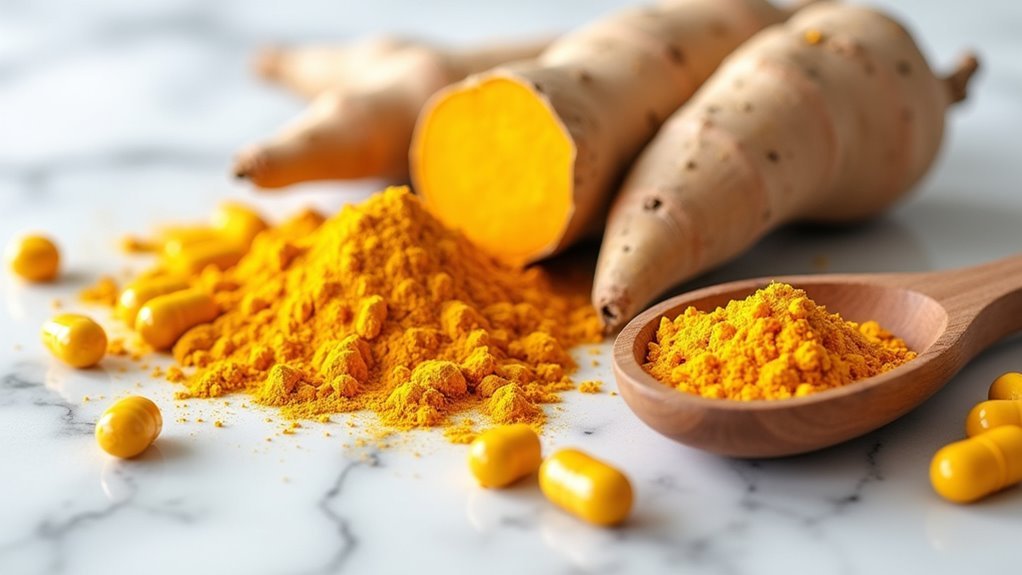
When you’re dealing with persistent inflammation in your body, turmeric’s active compound curcumin offers a scientifically-backed solution that can considerably reduce key inflammatory markers like C-reactive protein and interleukin-6.
This powerful anti-inflammatory compound rivals conventional medications like ibuprofen in effectiveness, particularly for conditions such as osteoarthritis.
The health benefits of turmeric extend beyond simple pain relief. Since chronic inflammation contributes to serious conditions including heart disease, diabetes, Alzheimer’s, and cancer, incorporating curcumin into your routine becomes an essential preventative strategy.
Since chronic inflammation fuels serious diseases like heart disease and cancer, curcumin becomes essential for prevention.
You’ll find that turmeric can enhance treatment outcomes when combined with traditional medications, as studies show improved remission rates in ulcerative colitis patients.
Understanding the best dosage—typically 500 to 2,000 mg daily—ensures you’re maximizing curcumin’s anti-inflammatory potential.
Optimal Daily Dosage for Inflammation Relief
Finding the right turmeric dosage for inflammation relief requires understanding research-backed guidelines that typically recommend 500-2,000 mg of curcumin daily.
You’ll need to calculate your ideal amount based on your body weight, following WHO recommendations of approximately 1.4 mg per pound.
The timing and frequency of your doses throughout the day can greatly impact how effectively your body absorbs and utilizes turmeric’s anti-inflammatory compounds.
Research-Based Dosage Guidelines
Since curcumin’s anti-inflammatory effects depend heavily on proper dosing, understanding research-backed guidelines guarantees you’ll get meaningful results from your supplementation.
Clinical studies demonstrate that turmeric curcumin dosage between 500-2,000 mg daily delivers ideal anti-inflammatory benefits when taken as standardized extracts rather than whole spice.
For osteoarthritis relief, research supports 500 mg taken two to four times daily for four to twelve weeks.
The WHO establishes safe daily intake at 1.4 mg per pound of body weight, equaling roughly 200 mg curcumin for a 150-pound person.
Studies show you can safely consume up to 8,000 mg daily, though you shouldn’t exceed 8 grams.
To maximize absorption, take your supplement with black pepper and fatty foods, as this combination increases bioavailability by up to 2,000%.
Body Weight Calculations
Your body weight serves as the foundation for calculating your ideal curcumin dosage, with the WHO’s standard recommendation of 1.4 mg per pound providing a reliable starting point for anti-inflammatory benefits.
For effective daily intake calculations, multiply your weight by 1.4 to determine your baseline turmeric dosage. A 150-pound person would require approximately 210 mg of curcumin daily for general health maintenance.
However, you can safely increase this amount for enhanced anti-inflammatory effects. Clinical studies demonstrate that doses between 500-2,000 mg daily effectively reduce inflammation markers without adverse reactions.
You’ll want to adjust your body weight calculations based on your specific inflammatory conditions, remembering that doses up to 8,000 mg remain within safe parameters for most individuals seeking therapeutic benefits.
Timing and Frequency
While determining your ideal curcumin dosage provides the foundation, establishing the right timing and frequency maximizes your anti-inflammatory results.
You’ll achieve peak benefits by dividing your turmeric dosage into two daily servings, spacing them 8 to 12 hours apart. This approach maintains consistent curcumin levels in your bloodstream throughout the day.
When taking turmeric supplements, consume them shortly before or after meals to enhance absorption. Your digestive system processes the active compounds more effectively when food is present.
For maximum bioavailability, take your doses of curcumin with black pepper, which contains piperine and can boost absorption by up to 2,000%.
This strategic frequency guarantees your body maintains steady anti-inflammatory compound levels, delivering more consistent therapeutic effects than single daily dosing.
Best Time of Day to Take Turmeric Curcumin
When should you take turmeric curcumin to maximize its anti-inflammatory benefits?
The best time to take turmeric curcumin is with meals, as dietary fats greatly enhance absorption. You’ll want to split your daily dose into two portions taken 8 to 12 hours apart for ideal results and fewer side effects.
Take turmeric curcumin with meals and split your daily dose into two portions 8-12 hours apart for optimal absorption.
Morning doses kickstart your day with powerful anti-inflammatory benefits, while evening doses support recovery and relaxation. Taking turmeric curcumin shortly before or after eating guarantees your body absorbs the greatest amount of active compounds.
For enhanced absorption, combine your supplement with black pepper, which can boost curcumin uptake by up to 2,000%.
Aim for 500-2,000 mg daily, adjusting based on your individual needs and responses to refine your anti-inflammatory routine.
Enhancing Absorption With Black Pepper and Healthy Fats
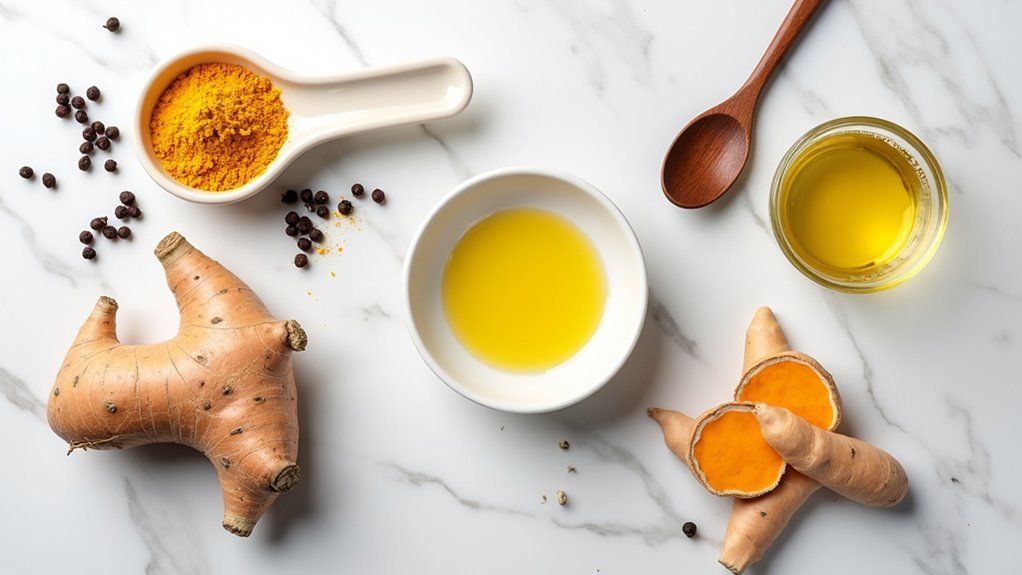
You’ll dramatically boost turmeric’s effectiveness by pairing it with black pepper, as the piperine compound can increase curcumin absorption by up to 2,000%.
Since curcumin is fat-soluble, you should also consume your turmeric with healthy fats like olive oil, coconut oil, or avocado to maximize bioavailability.
This powerful combination guarantees you’re getting the most anti-inflammatory benefits from every dose you take.
Black Pepper Enhancement
Although turmeric offers impressive anti-inflammatory properties on its own, you can greatly boost its effectiveness by combining it with black pepper and healthy fats.
Black pepper contains piperine, a compound that enhances curcumin absorption by up to 2,000%. This remarkable increase makes your turmeric considerably more potent and therapeutic.
Here’s how black pepper maximizes turmeric’s anti-inflammatory benefits:
- Add a pinch of black pepper to any turmeric-containing meal or supplement for ideal absorption
- Combine with healthy fats like olive oil or coconut oil since curcumin is fat-soluble
- Take with meals rather than on an empty stomach to maximize bioavailability
This simple combination transforms ordinary turmeric into a powerhouse anti-inflammatory tool, ensuring you receive maximum therapeutic value from every dose.
Fatty Food Synergy
Since curcumin dissolves in fat rather than water, pairing turmeric with healthy fats creates a powerful synergy that dramatically improves your body’s ability to absorb this anti-inflammatory compound.
When you combine turmeric with avocado, olive oil, coconut oil, or nuts, you’re maximizing curcumin absorption by making it more bioavailable to your system.
Adding black pepper to this fat-rich combination creates the ultimate absorption trio. The piperine in black pepper can boost curcumin absorption by up to 2,000%, while healthy fats guarantee peak uptake.
This synergistic approach delivers superior anti-inflammatory effects compared to taking turmeric alone.
To enhance efficacy, consume turmeric during meals containing both piperine and healthy fats, or choose supplements specifically formulated with these absorption-boosting compounds.
Cooking Methods That Preserve Curcumin Potency
When cooking with turmeric, the methods you choose directly impact how much curcumin your body can actually use. Smart cooking methods preserve curcumin potency while maximizing absorption for ideal anti-inflammatory effects.
Follow these guidelines to maintain turmeric’s therapeutic benefits:
- Keep heat low and time short – Cook turmeric for less than 15 minutes using gentle heat to prevent degradation of active compounds that provide anti-inflammatory effects.
- Add healthy fats during cooking – Include olive oil or coconut oil in your recipes since curcumin’s fat-soluble nature requires these fats for proper absorption.
- Incorporate into versatile dishes – Use turmeric in soups, curries, and stir-fries where you can control temperature and cooking time while creating flavorful meals.
Avoid prolonged high heat, which destroys curcumin’s beneficial properties.
Adding Turmeric to Soups and Curries
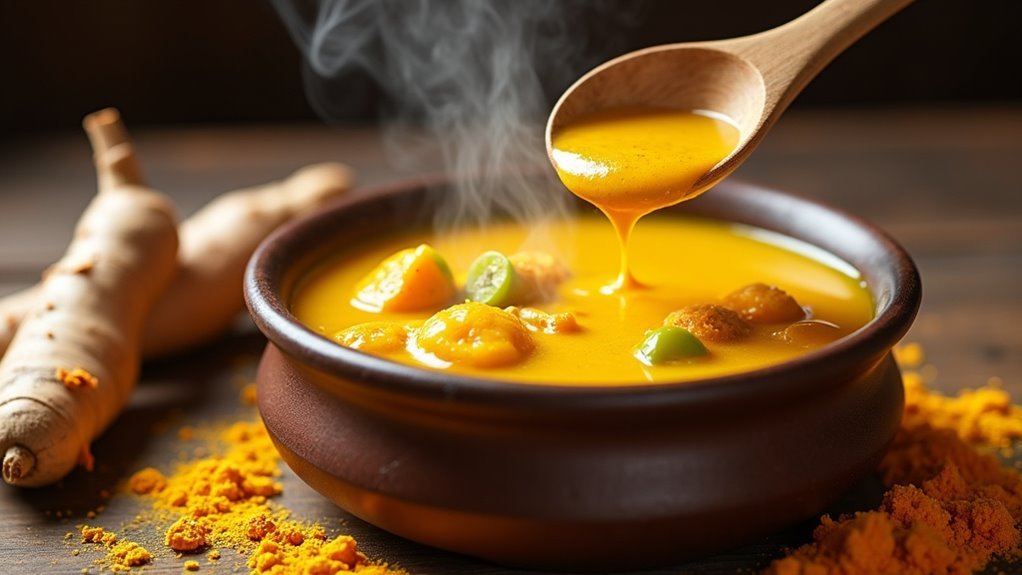
Two versatile cooking methods—soups and curries—offer perfect opportunities to incorporate turmeric while preserving its anti-inflammatory properties. You’ll maximize curcumin absorption by adding black pepper, which increases bioavailability by up to 2,000%. Simmer your soups under 15 minutes to maintain potency while blending turmeric with complementary spices like ginger and garlic.
| Ingredient Combination | Anti-Inflammatory Benefit |
|---|---|
| Turmeric + Black Pepper | Enhanced curcumin absorption |
| Turmeric + Ginger | Dual inflammation reduction |
| Turmeric + Garlic | Antioxidant synergy |
| Turmeric + Coconut Oil | Fat-soluble vitamin delivery |
| Turmeric + Onions | Quercetin amplification |
Traditional Indian diets provide 2-2.5 grams of turmeric daily through curries, delivering 60-100mg of curcumin. You can easily achieve these therapeutic doses by incorporating turmeric into your regular soups and curries.
Creating Anti-Inflammatory Smoothies With Turmeric
You can transform your daily smoothie into an anti-inflammatory powerhouse by incorporating turmeric with the right base ingredients and absorption enhancers.
The key lies in understanding which combinations maximize curcumin’s bioavailability while creating delicious flavors that mask turmeric’s earthy taste.
Getting your dosage right guarantees you’ll receive therapeutic benefits without overwhelming your palate or digestive system.
Turmeric Smoothie Base Ingredients
Creating the perfect anti-inflammatory smoothie starts with selecting base ingredients that work synergistically with turmeric’s powerful curcumin compound.
Since curcumin is fat-soluble, you’ll need healthy fats to maximize absorption and unleash turmeric’s full anti-inflammatory potential.
Your smoothie foundation should include:
- Fat sources – Add avocado, almond butter, or coconut yogurt to enhance curcumin absorption while creating a creamy texture that makes your smoothie more satisfying.
- Absorption enhancer – Include a pinch of black pepper, as its piperine content can boost curcumin absorption by up to 2,000%, dramatically amplifying your smoothie’s anti-inflammatory effects.
- Nutrient boosters – Incorporate leafy greens like spinach for additional antioxidants, plus anti-inflammatory fruits such as pineapple or mango for natural sweetness and bromelain.
Absorption-Enhancing Smoothie Combinations
While turmeric provides potent curcumin, strategic ingredient combinations can dramatically boost your body’s ability to absorb and utilize this powerful anti-inflammatory compound.
Black pepper is your secret weapon for maximum curcumin absorption. Just a pinch of black pepper containing piperine can increase uptake by an astounding 2,000%.
You’ll want to add healthy fats like avocado, coconut milk, or nut butters to your smoothie since curcumin is fat-soluble and requires fats for ideal absorption.
Enhance your smoothie’s effectiveness by including quercetin-rich fruits such as berries or apples, which further improve curcumin bioavailability.
Combine these with anti-inflammatory leafy greens like spinach or kale for a nutrient-dense beverage that maximizes both absorption and health benefits.
Daily Smoothie Dosage Guidelines
Finding the right turmeric dosage for your daily smoothie guarantees you’ll maximize anti-inflammatory benefits without overwhelming your taste buds. The ideal amount delivers powerful curcumin without creating an overly earthy flavor that masks your favorite fruits.
Here’s your daily turmeric powder dosage guide:
- Start with 1/2 teaspoon (1-3 grams) of turmeric powder per smoothie to provide sufficient curcumin for anti-inflammatory effects.
- Add a pinch of black pepper to boost curcumin absorption by up to 2,000% and enhance bioavailability.
- Consume turmeric smoothies 1-3 times weekly to maintain consistent curcumin levels in your system for best health benefits.
This dosing strategy guarantees you’re getting effective anti-inflammatory compounds while keeping flavors balanced and enjoyable in your daily routine.
Golden Milk and Turmeric Tea Recipes
To harness turmeric’s anti-inflammatory power in a delicious and accessible way, golden milk and turmeric tea offer ideal daily solutions that you can easily prepare at home.
| Recipe | Base Ingredients | Enhancement Tips |
|---|---|---|
| Golden Milk | 1-2 tsp turmeric, warm milk, black pepper | Add coconut oil or ghee for curcumin absorption |
| Turmeric Tea | 1 tsp turmeric, water, optional ginger/lemon | Include pinch of black pepper and cinnamon |
| Both Recipes | Honey or sweetener to taste | Combine with healthy fats for maximum benefits |
You’ll maximize curcumin absorption by adding black pepper, which can increase bioavailability by up to 2,000%. Including healthy fats like coconut oil further enhances absorption while delivering potent anti-inflammatory benefits. Enjoy these warming beverages daily for ideal results.
Supplement Forms vs. Whole Food Sources
Beyond preparing turmeric beverages at home, you’ll need to decide whether supplements or whole food sources better meet your anti-inflammatory goals.
Whole food sources like cooking spices provide only 2-5% curcuminoids and deliver roughly 60-100mg curcumin per daily serving. While this amount may not achieve therapeutic effects, you can easily incorporate turmeric into soups, curries, and smoothies for consistent intake.
While whole food turmeric sources offer modest curcumin levels, they provide an accessible way to maintain consistent anti-inflammatory intake through everyday cooking.
Supplements offer concentrated curcumin with enhanced absorption formulations. Many include piperine, which boosts uptake by 2,000%.
Consider these key factors when choosing:
- Concentration needs – Supplements provide higher curcumin levels for targeted anti-inflammatory effects.
- Absorption enhancement – Supplement formulations often include bioavailability boosters.
- Medical consultation – High doses exceeding 500mg daily require healthcare provider guidance due to potential interactions.
Combining Turmeric With Other Anti-Inflammatory Foods
While turmeric provides potent anti-inflammatory compounds on its own, you’ll maximize its therapeutic potential by strategically pairing it with complementary foods that enhance absorption and create synergistic effects.
Black pepper dramatically boosts curcumin absorption by up to 2,000% through its active compound piperine. You’ll also want to include healthy fats like olive oil or avocado since curcumin is fat-soluble. Combining turmeric with other anti-inflammatory powerhouses amplifies your results.
| Food Pairing | Anti-Inflammatory Benefit |
|---|---|
| Ginger + Garlic | Synergistic inflammation reduction |
| Fatty Fish + Flaxseeds | Omega-3 enhanced joint/heart health |
| Onions + Apples | Quercetin boosts curcumin absorption |
| Leafy Greens | Additional antioxidant protection |
These strategic combinations transform turmeric from a single ingredient into an all-encompassing anti-inflammatory system.
Potential Side Effects and Safety Considerations
Although turmeric offers impressive anti-inflammatory benefits, you’ll need to understand its potential side effects and safety considerations before incorporating high doses into your routine.
Common side effects include nausea, diarrhea, stomach pain, and allergic reactions like rash or hives, especially when taking high doses above 500 mg daily. You can minimize these effects by taking turmeric with food.
Here are three important safety considerations:
- Medical conditions: Avoid turmeric if you have gallbladder disease or kidney stones, as its oxalate content may worsen these conditions.
- Pregnancy and children: Pregnant or nursing women shouldn’t take supplements due to insufficient safety data, while children should stick to culinary amounts.
- Drug interactions: Turmeric may interact with certain medications like blood thinners and diabetes drugs, requiring healthcare supervision.
Who Should Avoid Turmeric Supplementation
Despite turmeric’s widespread safety profile, certain individuals should completely avoid turmeric supplementation due to heightened health risks.
If you’re pregnant or nursing, skip supplements entirely since there’s insufficient safety data for these critical stages.
You should avoid turmeric if you have bleeding disorders, as curcumin slows blood clotting and increases bleeding risk.
Those prone to kidney stones must exercise extreme caution due to turmeric’s high oxalate content, which contributes to stone formation.
People with gallbladder disease shouldn’t use supplements since turmeric stimulates bile production, potentially worsening symptoms.
Diabetics must consult healthcare providers before use, as turmeric may interact with medications and dangerously lower blood sugar levels.
Always prioritize safety over potential benefits.
Drug Interactions and Medical Precautions
Beyond individual health conditions, turmeric’s powerful compounds can greatly alter how your medications work, creating potentially dangerous interactions that require careful medical oversight.
If you’re taking prescription drugs, these medical precautions are essential:
- Blood thinners require extreme caution – Turmeric’s curcumin can amplify anticoagulant effects, considerably increasing your bleeding risk. You’ll need frequent monitoring and possible dosage adjustments.
- Diabetes medications need careful coordination – Since turmeric naturally lowers blood sugar, combining it with diabetes drugs can cause dangerous hypoglycemia. Monitor your glucose levels closely and work with your doctor.
- Gallbladder disease makes turmeric risky – The spice stimulates bile production, potentially worsening gallbladder symptoms and causing painful flare-ups.
Always consult your healthcare provider before starting turmeric supplements, especially when managing chronic conditions or taking multiple medications.
Tracking Your Anti-Inflammatory Progress
You can’t know if turmeric curcumin is working without tracking your progress systematically.
Monitor inflammation markers through blood tests that measure C-reactive protein levels and other inflammatory indicators.
Document physical improvements by keeping a daily journal of symptoms like joint pain, swelling, and overall energy levels.
Monitor Inflammation Markers
While turmeric curcumin offers promising anti-inflammatory benefits, you’ll need objective data to determine if it’s actually working for your specific situation.
To monitor inflammation markers effectively and track your progress with turmeric curcumin supplementation, consider these essential steps:
- Schedule regular blood tests to measure C-reactive protein (CRP) and interleukin-6 (IL-6) levels, which provide quantitative data on your body’s inflammatory response.
- Keep a detailed journal tracking your turmeric dosage, dietary intake, and corresponding inflammation marker results to identify patterns and optimize your anti-inflammatory strategy.
- Consult your healthcare provider to properly interpret inflammation marker results and make informed adjustments to your supplementation routine.
This systematic approach guarantees you’re maximizing turmeric’s potential for reducing inflammation while maintaining safety.
Document Physical Improvements
Blood tests provide valuable baseline data, but documenting your day-to-day physical improvements offers equally important insights into turmeric curcumin’s anti-inflammatory effects.
Keep a daily journal to track specific metrics like joint pain levels on a 1-10 scale and symptom frequency. Record changes in medication usage or pain relief needs, as these indicate turmeric’s effectiveness against inflammation.
Document your exercise tolerance and ability to perform daily tasks—these functional improvements highlight turmeric’s real-world benefits. Note dietary and lifestyle changes alongside your supplementation to identify which factors contribute most to managing inflammation.
Recording physical improvements like increased mobility and reduced joint stiffness helps you quantify progress and recognize patterns related to your turmeric intake over time.
Frequently Asked Questions
How Much Turmeric Should I Take Daily for Inflammation?
You should take 500-2,000 mg of curcumin daily for inflammation, typically divided into two doses 8-12 hours apart. Combine it with black pepper to boost absorption by up to 2,000%.
What Is the Best Way to Take Turmeric for Inflammation?
You’ll get the best anti-inflammatory results by taking curcumin extract supplements with black pepper, consuming them with fatty meals, and spacing doses twice daily about 8-12 hours apart.
How Long Does It Take Turmeric to Start Reducing Inflammation?
You’ll typically start noticing turmeric’s anti-inflammatory effects within 1-3 weeks of consistent use. Some people experience relief from joint pain and swelling even faster, sometimes within just one week of supplementation.
What Happens to Your Body When You Take Turmeric Every Day?
When you take turmeric daily, you’ll reduce inflammation markers, boost antioxidant levels, improve joint health, and potentially enhance mental wellness. Your body becomes better protected against chronic diseases while experiencing less pain.


Leave a Reply