

You’ll test raw honey’s diastase enzyme activity using the Schade method, which requires a spectrophotometer, temperature-controlled water bath at 40°C, and acetate buffer solutions. Dissolve your honey sample in acetate buffer and distilled water, then measure starch breakdown through spectrophotometric analysis. Results above 8 Schade units indicate excellent quality meeting EU standards, while 3-8 units are acceptable for low-enzyme honeys. This thorough testing approach reveals essential insights about your honey’s authenticity and storage conditions.
Understanding Diastase Enzyme in Raw Honey
Why does diastase activity matter when you’re evaluating raw honey’s quality? This enzyme naturally converts starches into sugars in genuine raw honey, serving as a vital indicator of freshness and proper handling.
When you test for diastase activity, you’re fundamentally checking whether your honey has maintained its natural properties. The diastase number reveals essential information about storage conditions and heat treatment.
If you find levels below 8 Schade units, the honey doesn’t meet EU consumption standards. You’ll typically see diastase activity ranging from 4.61 to 12.75 units across different floral varieties.
Low readings signal poor storage or excessive heating, which degrades honey’s quality. Understanding this enzyme helps you distinguish between authentic raw honey and processed alternatives that’ve lost their beneficial properties.
Regulatory Requirements for Honey Diastase Activity
When you’re selling honey commercially, you must comply with strict regulatory standards that govern diastase enzyme activity levels. The EU Honey Directive requires a minimum of 8 Schade units for regular honey marketed for human consumption, while baker’s honey follows different criteria.
If your honey has naturally low enzyme content and HMF levels of ≤15 mg/kg, you’ll need at least 3 units of diastase activity to meet compliance standards.
These regulations exist because diastase activity indicates whether honey’s been overheated or poorly stored, directly affecting freshness and safety.
You’ll need to regularly test and monitor these levels to maintain product integrity and fulfill legal requirements. Proper testing guarantees your honey reaches consumers while meeting quality criteria mandated by regulatory frameworks.
Essential Equipment and Materials for Testing
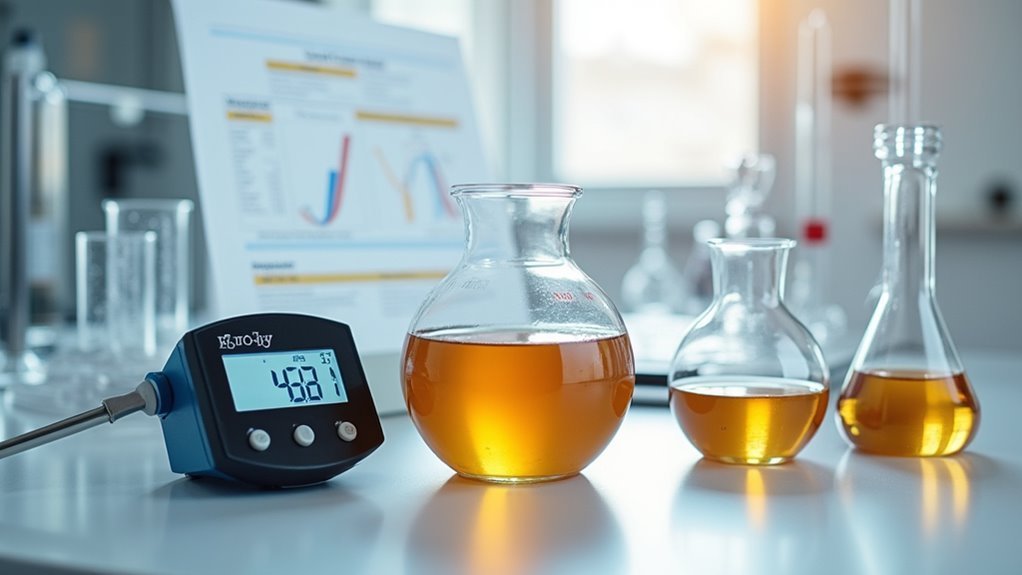
You’ll need specific laboratory equipment, chemical reagents, and sample preparation tools to accurately measure diastase enzyme activity in raw honey.
The testing process requires precise instruments like spectrophotometers and refractometers, along with standardized chemical solutions.
Having the right materials guarantees you’ll obtain reliable results that meet regulatory standards for honey quality assessment.
Laboratory Equipment Requirements
Precision forms the foundation of reliable diastase enzyme activity testing in raw honey samples.
You’ll need specialized laboratory equipment to guarantee accurate measurements and consistent results throughout your testing process.
Your essential equipment setup requires:
- Spectrophotometer – Measures absorbance changes during the enzymatic reaction to quantify diastase activity levels
- Temperature-controlled water bath – Maintains constant 40°C temperature for ideal enzyme performance during testing
- Analytical balance – Provides precise weighing of honey samples and reagents for accurate concentration calculations
- Volumetric glassware – Includes pipettes and flasks for exact measurement and dilution of samples
You’ll also need acetate buffer solutions to maintain proper pH conditions for the diastase enzyme.
This equipment combination guarantees you can conduct standardized testing protocols that deliver reliable, reproducible results for determining your honey’s enzyme activity.
Chemical Reagents Needed
Beyond laboratory equipment, specific chemical reagents form the backbone of accurate diastase enzyme testing. You’ll need an acetate buffer as your primary reagent to maintain stable pH conditions during diastase activity measurements.
The International Honey Commission recommends the Schade method for determining diastase number in honey samples intended for human consumption.
For the Phadebas® test, you’ll require specific substrate tablets that react with honey diastase to produce measurable color changes. Distilled water is essential for proper sample dilution, ensuring peak enzyme activity determination.
Raw honey samples require careful preparation since heating the honey or poor storage conditions can affect diastase values and HMF content.
You’ll also need spectrophotometric equipment and calibration standards to accurately measure enzyme content. Clean glassware and pipettes prevent contamination, ensuring reliable composition criteria assessment for various honey types, including Manuka honey.
Sample Preparation Tools
While chemical reagents provide the foundation for diastase testing, proper sample preparation tools guarantee accurate and reliable results.
You’ll need specific equipment to handle your honey samples correctly and maintain the integrity of the diastase enzyme throughout the testing process.
Essential sample preparation tools include:
- Clean sample containers – Use contaminant-free vessels to prevent interference with enzyme activity measurements
- Fine mesh strainer – Remove wax particles and debris from honey before testing to maintain sample purity
- Precision pipettes – Accurately measure honey samples and reagents for consistent results
- Refrigeration unit – Store samples at 4°C to preserve enzyme activity and prevent degradation before analysis
These tools work together with your acetate buffer and distilled water to create ideal testing conditions for reliable diastase activity measurements.
Preparing the Acetate Buffer Solution
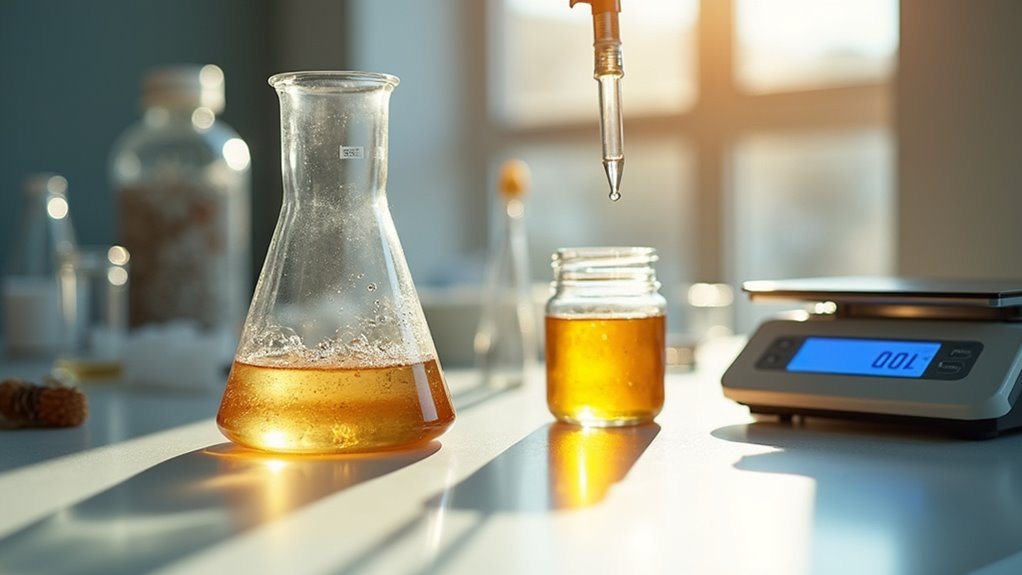
You’ll need to create a precise acetate buffer solution with specific composition requirements to maintain the ideal pH of 5.0 for diastase enzyme testing.
The pH adjustment process involves dissolving 4.1 grams of sodium acetate trihydrate in one liter of distilled water, then carefully adding acetic acid until you reach the target pH.
Proper storage and stability considerations are essential since you’ll want to use freshly prepared buffer solutions and store any remainder at 4°C for short-term use only.
Buffer Composition Requirements
Since diastase enzyme activity depends heavily on maintaining the correct pH environment, you’ll need to prepare an acetate buffer solution that keeps the pH at approximately 4.6. This specific pH level creates ideal conditions for the enzyme to function properly during testing.
Your buffer composition requires careful attention to achieve accurate results.
To create the proper buffer composition, you’ll need:
- 0.1 M acetic acid and 0.1 M sodium acetate – Mix these components in the correct ratio to reach pH 4.6
- Fresh preparation – Prepare the buffer solution immediately before testing to maintain pH stability
- Filtered solution – Remove all particulates that could interfere with spectrophotometric readings
- Adequate volume – Guarantee sufficient buffer quantity to properly dissolve your honey sample for testing
Ph Adjustment Process
When preparing your acetate buffer solution, start by measuring precise volumes of 0.1 M acetic acid and 0.1 M sodium acetate to achieve the target pH of 4.6.
You’ll need approximately 3 parts sodium acetate to 1 part acetic acid for this ideal pH range.
Mix the components slowly while monitoring the pH using a calibrated pH meter or precise pH strips.
Make small adjustments by adding drops of either component until you reach exactly 4.6.
Don’t rush this process—accurate pH is critical for reliable diastase activity measurements.
Once you’ve achieved the correct pH, store your buffer solution at 4°C until you’re ready to conduct the enzyme assay, ensuring maximum stability and effectiveness.
Storage and Stability
Proper storage conditions determine your acetate buffer’s reliability throughout the diastase testing process.
You’ll need to store your freshly prepared buffer at 4°C to maintain its stability and effectiveness.
Don’t let the solution sit too long, as prolonged storage leads to pH alterations that’ll compromise your enzyme analysis results.
The buffer’s degradation affects enzyme activity measurements, so you should use it promptly after preparation.
Store the solution in clean glass containers to prevent contamination that could skew your test results.
- Keep acetate buffer refrigerated at 4°C immediately after preparation
- Use the buffer solution within hours to prevent enzyme degradation
- Store only in clean glass containers to avoid contamination
- Monitor pH levels if storage extends beyond recommended timeframes
Sample Collection and Storage Methods
To obtain reliable diastase enzyme activity measurements, you’ll need to collect honey samples directly from beekeepers, ensuring minimal contamination while preserving the raw characteristics essential for accurate testing.
Collect 1 kg from each source to provide adequate material for thorough analysis. After collection, strain the honey to remove wax and impurities, applying moderate warming only if necessary to avoid quality degradation.
Store your purified samples at 4°C to prevent enzyme degradation and maintain diastase activity integrity. Label each sample with collection date, floral source, and geographic location—this information helps correlate enzyme activity with environmental factors.
Analyze samples promptly after collection, as diastase levels degrade over time when exposed to heat or improper storage conditions.
The Schade Method Protocol
Once you’ve properly collected and stored your honey samples, the Schade method provides the industry-standard approach for measuring diastase enzyme activity with reliable, quantifiable results.
You’ll start by dissolving your honey in acetate buffer and distilled water to create an analyzable solution. The method works by measuring starch concentration reduction through spectrophotometer analysis, with results expressed in Schade units. This official procedure gives you critical insights into your honey’s processing and storage history.
To guarantee accuracy, you’ll need to establish a standard calibration curve that allows meaningful comparison between different samples. The method’s reliability comes from extensive interlaboratory trials, making it the go-to quality control measure throughout the honey industry.
- Dissolve honey in acetate buffer solution for proper pH conditions
- Use spectrophotometer to measure starch breakdown at specific wavelengths
- Compare results against standardized calibration curve for accuracy
- Express final diastase activity measurements in official Schade units
Spectrophotometric Measurement Techniques
When you measure diastase activity using spectrophotometric techniques, you’re leveraging the enzyme’s ability to break down starch molecules at precisely controlled wavelengths. You’ll dissolve your honey sample in acetate buffer and distilled water, creating the perfect medium for analysis.
The spectrophotometer measures absorbance changes as diastase breaks down starch substrates. You’ll need calibration curves using known diastase concentrations to verify accuracy. Your results will be expressed in Schade units, where higher values indicate greater enzymatic activity and fresher honey.
| Parameter | Specification |
|---|---|
| Buffer Solution | Acetate buffer + distilled water |
| Measurement Units | Schade units |
| Quality Indicator | Higher values = better activity |
This method’s precision makes it ideal for quality control in honey production and analysis.
Alternative Phadebas Testing Approach
You’ll find the Phadebas IHC method offers a modern alternative to traditional diastase testing that’s both more precise and selective than conventional approaches.
This technique reduces your reagent costs and labor time while maintaining the accuracy you need for reliable honey quality assessment.
You can implement this cost-effective testing solution with confidence, knowing it’s been validated through extensive interlaboratory trials and aligns with ISO 9001 quality standards.
Phadebas IHC Method
The Phadebas IHC method represents a streamlined approach to measuring diastase activity in honey, offering enhanced precision and selectivity over traditional testing protocols.
You’ll find this method particularly valuable for quality control applications, as it helps you assess honey’s freshness and storage conditions accurately.
The simplified format reduces both reagent consumption and labor time while maintaining analytical performance standards validated through rigorous interlaboratory trials.
- Cost-effective alternative – Provides reliable results at a lower cost than the Schade method
- Reduced resource requirements – Uses fewer reagents and requires less laboratory time
- ISO 9001 compliance – Follows strict guidelines ensuring consistent and reliable honey analysis
- Enhanced precision – Delivers improved selectivity and accuracy for diastase activity measurements
Cost-Effective Testing Alternative
Since laboratory budgets continue tightening across the food testing industry, switching to the Phadebas Honey Diastase Test can slash your operational costs while delivering superior analytical performance. You’ll reduce reagent consumption and labor hours greatly compared to traditional Schade methods.
| Testing Aspect | Traditional Schade | Phadebas IHC |
|---|---|---|
| Reagent Requirements | High volume needed | Minimal reagents |
| Labor Time | Extensive manual work | Streamlined process |
| Result Turnaround | Extended processing | 10 working days |
The Phadebas method’s ISO 9001 compliance guarantees you’re meeting international honey quality standards without budget strain. Through validated interlaboratory trials, this cost-effective alternative proves its reliability for routine testing operations, making it ideal for both honey producers and quality control laboratories seeking efficient, economical solutions.
Interpreting Schade Unit Results
Once you’ve completed the diastase enzyme test, understanding what your Schade unit results reveal about honey quality becomes essential for determining whether the sample meets regulatory standards.
Your results indicate different quality levels depending on the values obtained:
- Above 8 Schade units: Your honey meets EU regulatory standards for human consumption and indicates excellent quality with minimal heat damage or degradation.
- 3-8 Schade units: Acceptable for honeys with naturally low enzyme content, provided HMF levels remain at 15 mg/kg or below.
- Below 3 Schade units: Your honey fails quality standards and likely experienced excessive heating, poor storage conditions, or significant deterioration.
- 4.61-12.75 range: Normal variation found in quality floral honeys, with higher values indicating superior freshness and proper handling.
These measurements help you assess whether your honey maintains its natural properties and market value.
Quality Control and Validation Steps
While accurate Schade unit measurements provide valuable data, implementing proper quality control and validation steps guarantees your diastase testing delivers reliable, defensible results.
You’ll need to establish consistent protocols that monitor multiple quality indicators simultaneously. Don’t rely solely on diastase activity—you must also track free acidity and pH levels to secure thorough quality assessment.
Validate your testing methods through regular calibration of spectrophotometric equipment and participation in interlaboratory trials. You should implement the Phadebas Honey Diastase Test, which follows ISO 9001 standards for enhanced precision.
Document all procedures and maintain detailed records of environmental conditions during testing. This systematic approach helps you identify quality variations from floral sources, storage practices, and environmental factors while securing compliance with international standards.
Factors Affecting Diastase Activity Levels
Understanding the factors that influence diastase activity levels helps you predict and control honey quality variations throughout production and storage. Several key elements directly impact enzyme activity in your honey samples.
Temperature exposure greatly affects diastase levels. When you subject honey to higher temperatures, you’ll see enzyme degradation that lowers diastase activity over time.
High temperatures accelerate enzyme breakdown, causing diastase activity to decline and compromising honey’s natural quality markers over time.
Your storage conditions matter too – humidity and light exposure can trigger fermentation and reduce enzyme function.
Key factors affecting diastase activity include:
- Floral source – Erica arborea honey shows higher diastase levels than Lathyrus sativus varieties
- Environmental conditions – Climate and harvesting season alter nectar composition and bee behavior
- Storage parameters – High moisture, light exposure, and temperature fluctuations degrade enzymes
- Honey age – Older honey naturally develops decreased enzyme activity through degradation processes
Troubleshooting Common Testing Issues
Even when you follow proper testing procedures, diastase activity measurements can produce inconsistent or unexpected results that require systematic troubleshooting.
Start by examining your honey samples for wax particles, debris, or other contaminants that interfere with enzyme activity readings. If you’re getting low diastase values, check whether you’ve maintained proper 4°C storage temperatures throughout your testing process.
When using the Schade method, verify that you’ve completely dissolved the honey in acetate buffer and distilled water – incomplete mixing leads to inaccurate results.
Don’t forget to calibrate your equipment regularly and validate methods against standard reference materials to eliminate systematic errors.
Remember that heat exposure during sample handling can permanently damage diastase enzymes, causing unexpectedly low activity measurements.
Comparing Results to International Standards
After obtaining your diastase activity measurements, you’ll need to compare them against established international quality benchmarks that determine whether your honey meets commercial standards.
For EU markets, your honey must show at least 8 diastase units for human consumption, though baker’s honey follows different criteria.
If your honey has low natural enzyme content with HMF levels at or below 15 mg/kg, you’ll only need 3 diastase units minimum.
- Standard honey: Requires minimum 8 diastase units for EU market approval
- Low enzyme honey: Needs only 3 diastase units when HMF ≤ 15 mg/kg
- Quality indicator: Higher diastase levels signal better freshness and minimal heat exposure
- Processing history: Low values suggest overheating or poor storage conditions affecting honey integrity
Frequently Asked Questions
How to Measure Diastase Activity in Honey?
You’ll measure diastase activity using the Schade method or Phadebas® Honey Diastase Test. These standardized tests determine enzyme levels, with results expressed in diastase units indicating your honey’s quality and processing history.
How Do You Test for Diastase Enzyme Activity?
You’ll test diastase enzyme activity by using either the Schade method or the more precise Phadebas® Honey Diastase Test, which measures enzyme levels to determine honey’s quality and processing history.
What Is the Enzyme Diastase in Honey?
Diastase is a naturally occurring enzyme you’ll find in honey that breaks down starches into simpler sugars. It’s produced by bees and indicates your honey’s freshness and quality.
Is High Diastase in Honey Good?
High diastase in your honey’s generally excellent, indicating freshness and quality. You’ll want levels above 8 Schade units for consumption, though extremely high values can negatively affect baking texture.


Leave a Reply