

Your raw honey’s valuable enzymes start breaking down at just 104°F (40°C), with significant damage occurring between 110°F and 120°F. Beyond 140°F, you’ll destroy most of the diastase, invertase, and glucose oxidase that give honey its digestive and antibacterial benefits. Keep temperatures below 104°F to preserve these therapeutic compounds – anything higher transforms your nutritious honey into simple sugar syrup. Understanding proper warming techniques guarantees you’ll maintain honey’s full enzymatic potential.
Understanding Raw Honey’s Enzyme Composition
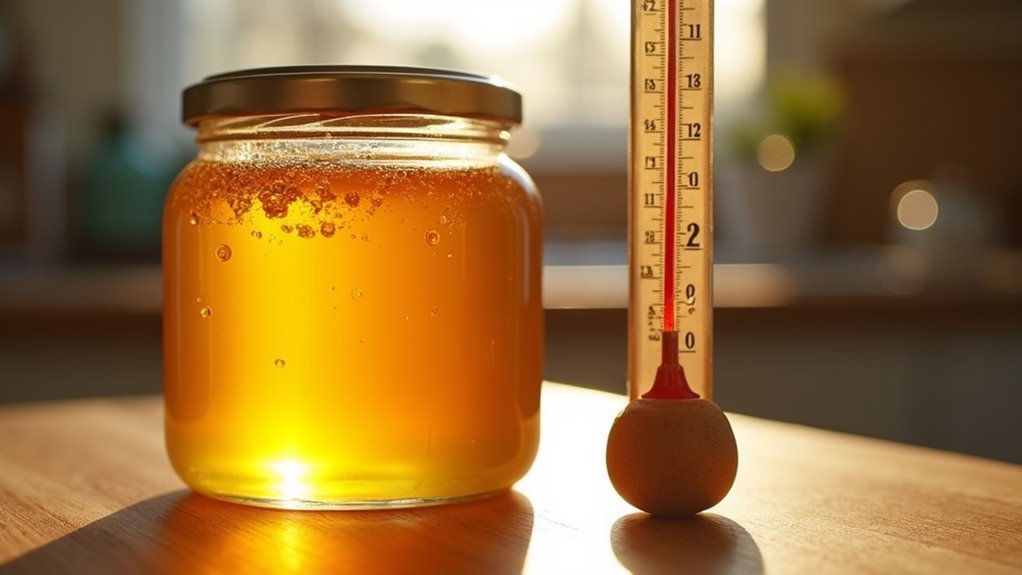
When you examine raw honey at the molecular level, you’ll discover a complex ecosystem of naturally occurring enzymes that transform this golden substance into far more than just a sweetener.
These essential enzymes include diastase, invertase, and glucose oxidase, each serving specific functions that contribute to honey’s remarkable properties.
Diastase breaks down starches into simpler sugars, making honey easier to digest. Invertase converts complex sugars into glucose and fructose, while glucose oxidase produces hydrogen peroxide, giving honey its natural antibacterial properties.
Together, these enzymes create honey’s unique nutritional value and therapeutic benefits.
However, this delicate enzyme system is extremely sensitive to heating. Understanding their composition helps you appreciate why temperature control is vital for maintaining honey’s beneficial properties and preserving its natural healing potential.
The Critical Temperature Threshold for Enzyme Destruction
The moment raw honey reaches 104°F (40°C), its precious enzymes begin their irreversible breakdown, marking the start of a vital temperature threshold that determines whether you’ll retain honey’s natural benefits or lose them forever.
When you heat honey beyond this point, you’re fundamentally destroying the beneficial enzymes that make raw honey so valuable. The enzyme invertase, essential for sugar breakdown, can’t survive high temperatures above 104°F. By 120°F, you’ll experience significant enzyme loss, while 140°F causes substantial property changes.
| Temperature | Enzyme Impact |
|---|---|
| Below 104°F | Enzymes preserved |
| 104°F-110°F | Breakdown begins |
| 110°F-120°F | Significant loss |
| 120°F-140°F | Major degradation |
| Above 140°F | Substantial damage |
Keep your honey below 110°F to maintain its natural enzymatic activity.
How Heat Affects Diastase and Invertase Activity
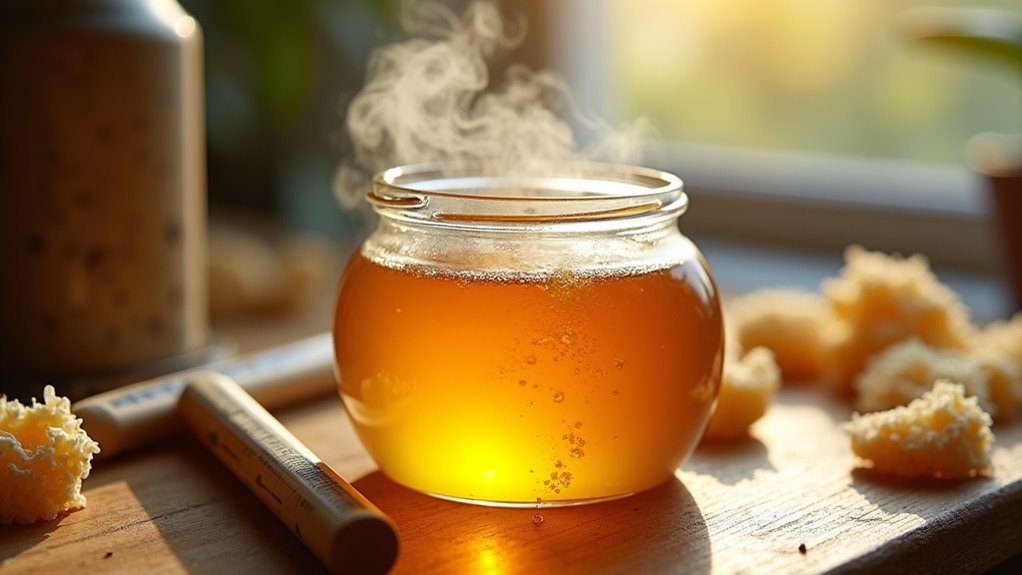
Understanding how heat specifically targets honey’s two most important enzymes—diastase and invertase—reveals why temperature control matters so critically for preserving raw honey’s benefits.
Temperature control is absolutely critical for preserving the delicate enzymes that give raw honey its remarkable therapeutic properties.
When you’re heating honey, invertase becomes vulnerable first, starting to break down at just 104°F (40°C). This enzyme helps your body digest honey more effectively and contributes to its health benefits.
Diastase follows closely behind, beginning its degradation process at 110°F (43°C). This enzyme breaks down starches into sugars, directly impacting honey’s nutritional quality.
As temperatures climb to 120°F (49°C) or higher, you’ll experience significant enzyme loss that affects honey’s natural antibacterial properties.
Beyond 140°F (60°C), prolonged exposure causes irreversible damage to both enzymes, permanently altering your honey’s composition and therapeutic value.
Antimicrobial Properties Lost Through Overheating
Beyond destroying essential enzymes, overheating honey delivers another devastating blow by stripping away its renowned antimicrobial properties that have made it a medicinal staple for thousands of years.
When you expose honey to temperatures exceeding 120°F, you’ll dramatically reduce its effectiveness against harmful bacteria. The heat disrupts honey’s natural antibacterial characteristics, which rely on specific compounds that become unstable at elevated temperatures.
You can’t reverse this damage once it occurs. Overheating honey transforms your potent natural antibiotic into a simple sweetener with minimal therapeutic value.
The antimicrobial properties that make raw honey effective for wound healing, sore throats, and digestive issues disappear when subjected to excessive heat. Keeping your honey below 104°F preserves these crucial health benefits intact.
Chemical Changes That Occur Above Safe Temperatures
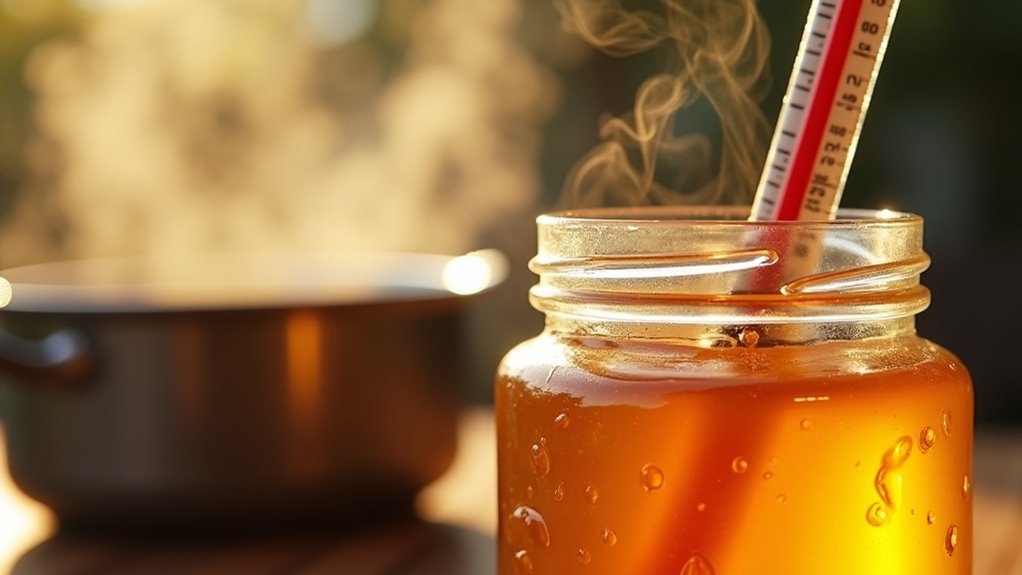
When you heat honey beyond safe temperature thresholds, you’re triggering a cascade of irreversible chemical reactions that fundamentally alter its molecular structure.
At 120°F and above, you’ll begin losing beneficial enzymes rapidly, with significant deterioration compromising honey’s health benefits.
Heating honey higher to 140°F devastates enzymatic activity, while temperatures exceeding 160°F cause caramelization—transforming natural sugars and creating entirely different flavor profiles.
Temperatures above 140°F destroy honey’s enzymatic benefits while extreme heat over 160°F triggers caramelization, fundamentally altering its natural composition.
You’ll also initiate the formation of hydroxymethylfurfural (HMF), a compound produced when fructose breaks down under prolonged heat exposure. This chemical byproduct can become harmful in excessive amounts.
These molecular changes aren’t merely cosmetic—they represent fundamental shifts in honey’s composition, stripping away the very properties that make raw honey valuable for health and wellness applications.
Comparing Raw vs. Heat-Treated Honey Benefits
While raw honey brings you a powerhouse of natural enzymes and bioactive compounds, heat-treated honey delivers convenience at the cost of nutritional integrity.
You’ll find that raw honey contains over 180 beneficial substances, including vitamins, minerals, and antioxidants that support your digestive health and provide antibacterial properties. The essential enzyme invertase remains intact, helping break down sugars effectively in your system.
In contrast, heat-treated honey loses nearly 200 beneficial components during processing above 160°F. You’re missing out on significant health benefits when choosing processed varieties.
The formation of HMF compounds above 120°F further diminishes quality and may pose health risks. While heat-treated honey offers longer shelf life and smoother texture, you’ll sacrifice the superior nutritional value that makes raw honey a true superfood.
Safe Methods for Warming Crystallized Honey
You can safely warm crystallized honey without destroying its valuable enzymes by using a gentle water bath method that keeps temperatures below 104°F (40°C).
Place your honey jar in lukewarm water for 5–10 minutes while stirring gently, ensuring even heating throughout the container.
This controlled approach preserves the honey’s beneficial properties while restoring it to a smooth, liquid consistency.
Gentle Water Bath Method
Although direct heating can quickly damage honey’s delicate enzymes, the gentle water bath method offers a safe alternative for warming crystallized honey back to its liquid state.
You’ll place your jar in warm water, keeping the temperature below 104°F (40°C) to preserve the benefits of raw honey. Stir occasionally during the 5-10 minute process to guarantee even warming and prevent hot spots.
This technique protects against excessive heat that destroys beneficial enzymes and nutrients. You should never use boiling water or direct heat sources, as they’ll rapidly elevate temperatures beyond safe levels.
The gentle water bath method effectively maintains your honey’s natural flavor profile and health properties while making it easier to use in recipes or enjoy directly.
Temperature Control Techniques
Mastering temperature control requires more than simply avoiding high heat—it demands precise monitoring and consistent technique throughout the warming process.
To implement effective temperature control techniques, you’ll need a reliable thermometer to track your warm water bath temperature continuously. Keep the water at or below 104°F (40°C) to protect natural enzymes from degradation.
Check the temperature every few minutes, adjusting as needed by adding cool water if it rises too high. Position your thermometer away from the honey jar to get accurate water readings.
Set a timer for 5–10 minutes to prevent overheating, and gently stir the honey periodically. This methodical approach guarantees you’ll safely decrystallize honey while preserving its beneficial properties.
Avoiding Enzyme Damage
Follow these essential steps to preserve your honey’s natural enzymes:
- Use a warm water bath with water temperature never exceeding 104°F – monitor with a thermometer for accuracy.
- Stir the honey gently while warming to distribute heat evenly and prevent dangerous hot spots that could spike temperatures.
- Remove the jar immediately once the honey softens to avoid prolonged heat exposure that compromises enzymatic activity.
Maintaining consistent temperature control below 104°F guarantees your honey retains its nutritional integrity and health benefits.
Storage Practices That Preserve Enzyme Activity
When you store raw honey properly, you’ll preserve its delicate enzymes and maintain its natural health benefits for years to come.
Keep your honey between 50°F and 70°F to protect these valuable compounds from degradation. Choose a cool, dark location away from direct sunlight and heat sources like stoves or radiators.
Avoid storing honey in areas with fluctuating temperatures, such as near windows or in garages, as these changes trigger chemical reactions that damage enzyme activity.
Your pantry or kitchen cabinet works perfectly for maintaining consistent conditions.
When you need to soften crystallized honey, use gentle warming methods.
Place the jar in a warm water bath rather than exposing it to high direct heat, which destroys the very benefits you’re trying to preserve.
Protecting Honey’s Therapeutic Value in Your Kitchen
Since raw honey’s therapeutic compounds remain fragile even after you’ve stored them correctly, you’ll need to handle them carefully during everyday kitchen use.
When honey is heated beyond 104°F, you’ll destroy the invertase and other essential enzymes that make raw honey so beneficial.
Here are three practical ways to protect honey’s therapeutic value in your kitchen:
- Use gentle warming methods – Place your honey jar in a warm water bath instead of microwaving or direct heating.
- Monitor temperatures carefully – Keep heating below 104°F to prevent valuable honey sugars becoming harmful compounds like HMF.
- Add honey after cooking – Stir honey into tea, oatmeal, or recipes only after they’ve cooled to body temperature (98.6°F).
Frequently Asked Questions
At What Temperature Does Raw Honey Lose Its Benefits?
You’ll notice raw honey starts losing its beneficial enzymes at 104°F, with significant degradation at 120°F. Don’t heat it above 110°F if you want to preserve its enzymatic activity and health benefits.
What Temperature Degrades Raw Honey?
You’ll start degrading raw honey’s beneficial properties when you heat it above 104°F. At 120°F, you’ll see significant enzyme loss, and you’ll destroy essential invertase enzymes completely at 140°F.
Does Hot Water Destroy the Enzymes in Honey?
Yes, hot water destroys honey’s enzymes. If you add honey to water above 104°F, you’ll damage invertase and other beneficial enzymes. You’ll preserve honey’s natural properties by using lukewarm water instead.
At What Temperature Does Honey Become Toxic?
Honey doesn’t become truly toxic at any temperature, but you’ll lose its beneficial enzymes above 120°F and create harmful compounds like HMF when you heat it beyond 160°F.


