
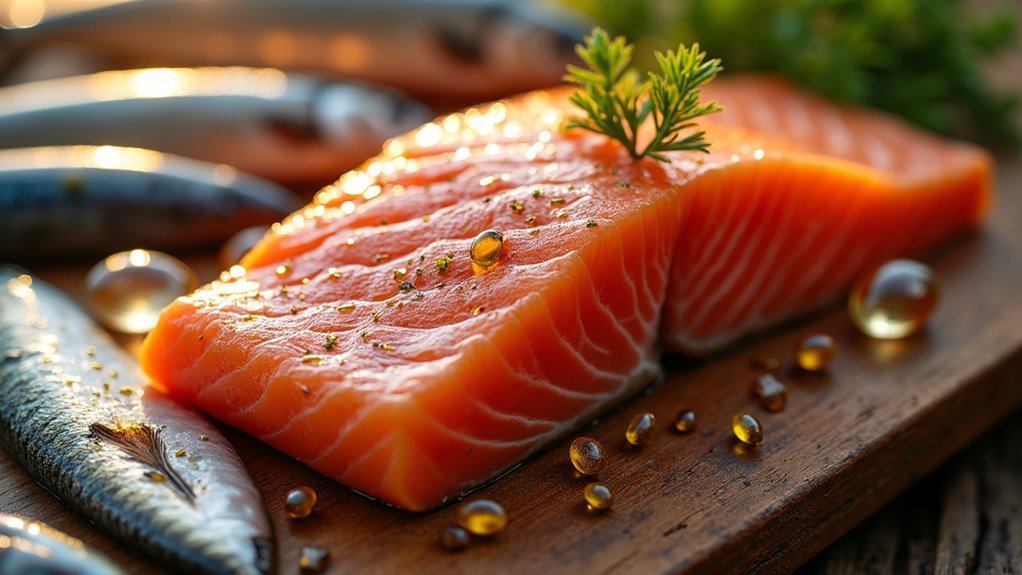
Fatty fish dramatically boost your vitamin D levels because they naturally accumulate this nutrient in their liver and fat tissues. You’ll get 556-924 IU from a single serving of wild salmon, while mackerel delivers 643 IU and sardines provide 193 IU per serving. These amounts far exceed fortified foods like milk, which only contains 60 IU per cup. Regular consumption twice weekly can increase your serum vitamin D by 6.8 nmol/L, making strategic fish choices essential for ideal nutritional benefits.
What Makes Fatty Fish Superior Vitamin D Sources
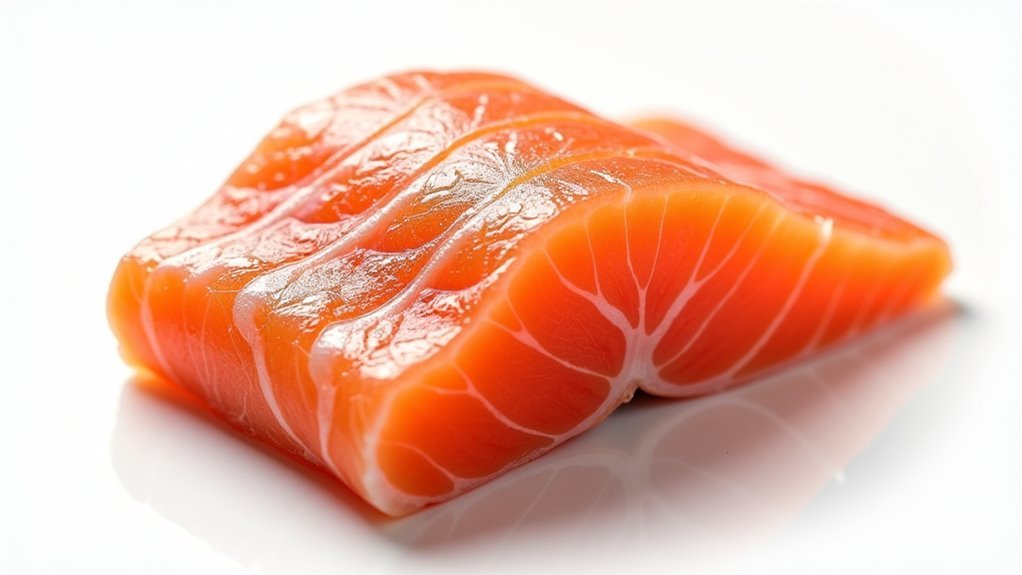
When you’re looking to boost your vitamin D intake naturally, fatty fish stand out as nutritional powerhouses that deliver impressive amounts of this essential nutrient.
You’ll find that wild-caught salmon provides between 556–924 IU per serving, markedly outperforming lean fish varieties. The secret lies in fat content—vitamin D accumulates in liver and fat tissues, making these fish superior dietary sources.
Wild-caught salmon delivers up to 924 IU of vitamin D per serving thanks to its high fat content where this nutrient accumulates.
You can rely on other fatty fish too. Herring and sardines offer substantial vitamin D content, with canned sardines providing 193 IU per serving for convenient daily intake.
When you consume fatty fish regularly, you’ll increase your serum 25-hydroxyvitamin D concentrations by an average of 6.8 nmol/L, making these fish essential for maintaining ideal vitamin D status year-round.
Salmon: The Vitamin D Powerhouse Among Seafood
Among all fatty fish varieties, salmon reigns supreme as nature’s most potent vitamin D source.
You’ll get approximately 441 IU of vitamin D from a 3.5-ounce serving of farmed Atlantic salmon, which covers 55% of your daily needs.
However, wild-caught salmon delivers even more impressive results, containing 556 to 924 IU per serving—that’s 70-116% of your daily value.
The vitamin D content varies greatly based on the salmon’s habitat and diet.
Wild varieties consistently outperform farmed ones due to their natural environment and feeding patterns.
By including salmon in your dietary routine, you’ll easily meet the recommended 600 IU daily allowance for adults.
Plus, you’re getting heart-healthy omega-3 fatty acids alongside this vital vitamin.
Mackerel and Sardines: Affordable High-Density Options
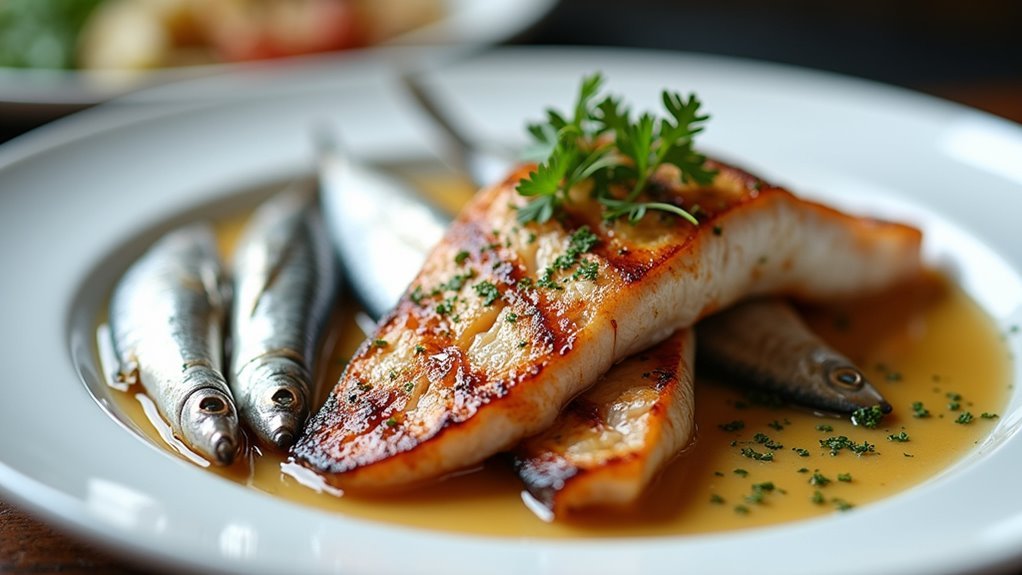
Budget-conscious consumers don’t need to sacrifice nutrition when seeking vitamin D-rich seafood options. Mackerel and sardines deliver exceptional vitamin D density without breaking your budget. You’ll get approximately 643 IU of vitamin D from a 3.5-ounce serving of mackerel, fulfilling 80% of your daily value. Canned sardines provide about 193 IU per serving while remaining incredibly affordable and convenient.
These powerhouse fish offer additional benefits beyond vitamin D:
- Rich omega-3 fatty acids supporting heart health
- Accessible pricing compared to premium fresh fish
- Long shelf life when purchased canned
- Versatile preparation options for various meals
Both mackerel and sardines rank among nature’s highest vitamin D sources, making them practical choices for combating deficiency.
You’re investing in premium nutrition without premium prices when choosing these affordable, nutrient-dense options.
How Fish Habitat Affects Vitamin D Content
When you’re choosing fish for vitamin D, you’ll find that wild-caught varieties consistently outperform their farmed counterparts.
Wild salmon contains 556-924 IU per 100 grams compared to considerably lower levels in farmed fish, demonstrating how natural habitats boost nutrient density.
Cold-water fish like mackerel and herring store even higher vitamin D levels since they feed on plankton-rich diets in their frigid ocean environments.
Wild Vs Farmed Fish
Although both wild and farmed fish provide valuable vitamin D, their habitat dramatically influences how much of this essential nutrient you’ll actually get on your plate.
When comparing wild and farmed Atlantic salmon, the difference is striking – wild-caught varieties deliver 556–924 IU per 3.5-ounce serving, while farmed versions contain around 441 IU.
This vitamin D content gap stems from fundamental environmental differences:
- Wild fatty fish access diverse planktonic sources rich in vitamin D
- Colder water habitats promote higher fat content and nutrient density
- Controlled farm diets can’t replicate natural feeding diversity
- Nutrient-rich wild environments allow fish to accumulate more vitamins naturally
Mackerel exemplifies this principle, providing 643 IU per serving due to its wild habitat and natural diet.
Cold Water Benefits
Cold-water environments create excellent conditions for vitamin D accumulation in fatty fish species.
When you’re choosing fish for ideal vitamin D content, you’ll find that cold-water environments greatly boost these levels compared to warmer waters. The North Atlantic’s frigid temperatures encourage fish to develop higher fat stores, which concentrate fat-soluble vitamins like vitamin D.
You’ll notice that plankton in cold-water environments contains more nutrients that fish convert into vitamin D.
Wild salmon thriving in these conditions can provide up to 924 IU per serving, while mackerel delivers 643 IU. The combination of increased sunlight exposure during migration and nutrient-rich cold-water diets creates this vitamin density advantage that you won’t find in warm-water species.
Wild-Caught Vs Farm-Raised: Vitamin D Differences
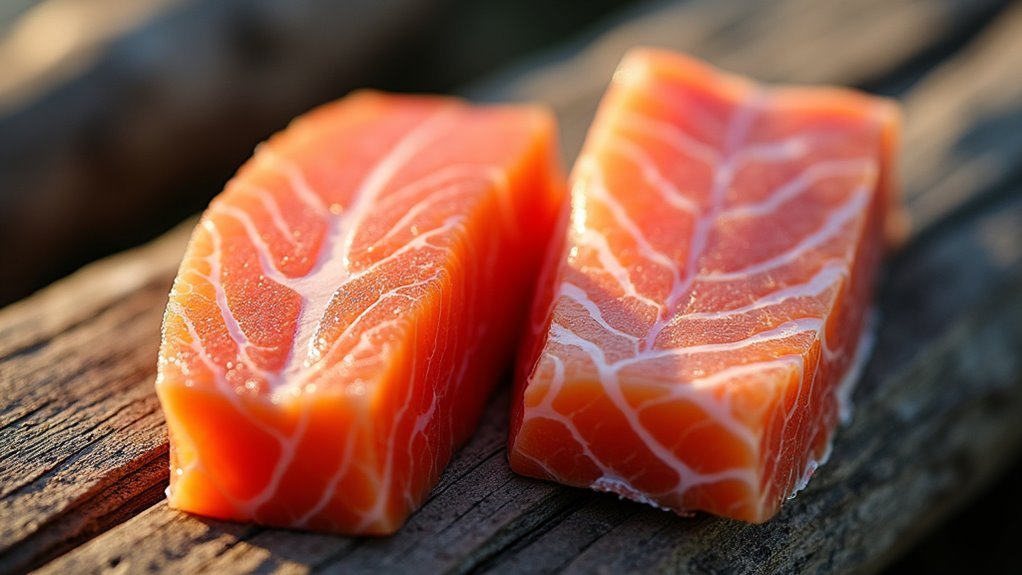
Since wild fish consume natural diets rich in plankton and other marine organisms, they’ll typically provide you with considerably higher vitamin D levels than their farm-raised counterparts.
Wild-caught salmon delivers 556 to 924 IU per 3.5-ounce serving, while farmed Atlantic salmon only contains about 441 IU. This difference stems from dietary variations between wild and controlled environments.
Consider these vitamin D powerhouses from the wild:
- Wild mackerel – delivers up to 643 IU per serving
- Fresh Atlantic herring – provides 167 IU per serving
- Wild salmon varieties – offer 25% more vitamin D than farmed versions
- Ocean-caught fish – benefit from natural plankton consumption
You’ll maximize your vitamin D intake by choosing wild-caught options whenever possible, as farm-raised fish lack access to the natural marine diet that boosts these essential nutrients.
Cod Liver Oil: Concentrated Vitamin D Alternative
When you’re looking for a vitamin D powerhouse that doesn’t require eating whole fish, cod liver oil delivers an impressive 450 IU per teaspoon—that’s 56% of your daily value in just one small dose.
This concentrated supplement proves especially valuable if you don’t regularly consume fish or live in areas with limited sunlight exposure.
Beyond vitamin D supplementation, you’ll also get beneficial omega-3 fatty acids that support heart health and reduce inflammation.
Cod liver oil provides dual benefits by delivering both essential vitamin D and heart-healthy omega-3 fatty acids in one supplement.
Cod liver oil becomes particularly important during winter months when natural vitamin D synthesis drops considerably.
If you’re dealing with vitamin D deficiency, this potent alternative offers a practical solution that’s more concentrated than most dietary sources, making it easier to maintain adequate vitamin D levels year-round.
Optimal Serving Sizes for Maximum Vitamin D Benefits
You’ll maximize your vitamin D intake by following specific serving size guidelines that vary depending on the type of fish you choose.
A standard 3.5-ounce portion of wild-caught salmon can deliver over 100% of your daily vitamin D needs, while the same amount of sardines provides only about 24%.
Your consumption frequency becomes essential when selecting lower vitamin D fish varieties, as you’ll need to eat them more often to meet your recommended daily allowance.
Standard Portion Guidelines
Two key serving sizes can help you maximize vitamin D benefits from fatty fish while meeting established health guidelines. The American Heart Association recommends consuming 3 ounces of cooked fatty fish twice weekly for ideal vitamin D intake.
However, understanding 3.5-ounce portions provides better insight into fish consumption benefits.
Consider these standard portions for maximum vitamin D absorption:
- Wild salmon: 3.5 ounces delivers 556-924 IU, making it an exceptional source of vitamin D
- Mackerel: 3.5 ounces provides approximately 643 IU, ranking among the most potent options
- Canned sardines: 3.5 ounces contains 193 IU with convenient shelf-stable storage
- Cod liver oil: One daily teaspoon offers 450 IU for non-fish eaters
These portions guarantee you’re meeting recommended guidelines while maximizing nutritional benefits.
Fish Type Considerations
While portion sizes provide a foundation for vitamin D intake, selecting the right fish types amplifies your nutritional results considerably.
Wild-caught salmon stands out as your best option, delivering up to 924 IU per 3.5-ounce serving. Mackerel follows closely, providing 643 IU and meeting 80% of your daily value needs.
If you’re seeking convenience, canned sardines offer 193 IU while remaining budget-friendly and shelf-stable. For concentrated supplementation, cod liver oil delivers 450 IU per teaspoon.
When choosing fatty fish, prioritize wild-caught varieties over farm-raised options, as they typically contain higher vitamin D concentrations.
Remember that darker, oilier fish generally provide more vitamin D than lighter varieties, making them superior choices for maximizing your intake.
Frequency Impact Analysis
Consistently eating fatty fish twice weekly creates the foundation for meaningful vitamin D improvements in your body. This frequency meets your dietary requirement while delivering measurable health benefits.
Research demonstrates that maintaining this schedule increases your serum 25-hydroxyvitamin D concentrations by 6.8 nmol/L on average, with long-term adherence showing even greater improvements of 8.3 nmol/L.
Your ideal serving strategy should include:
- 3-ounce portions of salmon, mackerel, or sardines per serving
- Twice-weekly consumption spaced throughout the week for consistent absorption
- Choosing fatty varieties over lean fish for maximum vitamin D content
- Sustained eating patterns maintained over months for cumulative benefits
Regular fatty fish consumption directly addresses vitamin D deficiency affecting 35% of U.S. adults, making frequency as vital as fish selection.
Research Evidence: Fish Consumption and Blood Vitamin D Levels
Research consistently demonstrates a strong connection between fish consumption and elevated vitamin D levels in your bloodstream.
Meta-analysis data reveals that eating fish increases your serum 25-hydroxyvitamin D concentrations by an average of 4.4 nmol/L. When you focus specifically on fatty fish like salmon and mackerel, you’ll see even greater benefits with mean increases of 6.8 nmol/L.
The timing of your fish consumption matters considerably. Short-term studies spanning 4-8 weeks show average increases of 3.8 nmol/L, while long-term consumption over six months delivers substantially higher gains of 8.3 nmol/L.
Surprisingly, research challenges traditional assumptions about fat content—lean fish like tilapia also contain meaningful vitamin D amounts, expanding your dietary options for boosting vitamin D status effectively.
Fatty Fish Vs Other Vitamin D Food Sources
When you’re choosing vitamin D sources, you’ll find that fatty fish consistently outperforms most other dietary options in both content and absorption efficiency.
While fortified foods like milk and cereals offer convenience, they can’t match the bioavailability of vitamin D3 found in salmon, mackerel, and sardines.
You’re also getting additional nutrients like omega-3 fatty acids and high-quality protein that other vitamin D sources simply don’t provide.
Vitamin D Content Comparison
While many foods contain vitamin D, fatty fish stands out as one of nature’s most potent sources of this essential nutrient.
When you’re comparing vitamin D levels across different food sources, the superiority of fatty fish becomes undeniably clear.
Consider these striking differences in vitamin D content:
- Wild-caught salmon: 556-924 IU per 3.5-ounce serving
- Cod liver oil: 450 IU per teaspoon
- Fortified cow’s milk: 111 IU per cup
- Large egg yolk: 41 IU each
Even canned sardines deliver 193 IU per serving, surpassing most fortified foods.
You’ll find that fatty fish consistently provides exponentially higher vitamin D levels than traditional sources like eggs or fortified dairy products, making them your most efficient dietary option for meeting daily requirements.
Bioavailability and Absorption Rates
Having more vitamin D in your food doesn’t guarantee your body will absorb it effectively. The bioavailability of vitamin D varies greatly between sources, with fatty fish leading the pack. When you eat salmon or mackerel, you’re getting vitamin D3 in a fat-rich environment that enhances absorption.
Studies show fatty fish consumption increases your serum vitamin D levels by 4.4 nmol/L on average, outperforming lean fish varieties.
The fat-soluble nature of vitamin D means your body absorbs it more effectively from fatty fish compared to fortified milk or soy alternatives. Unlike mushrooms or eggs that provide less potent vitamin D2, fatty fish delivers vitamin D3 – the superior form for boosting blood levels.
The omega-3 fatty acids in these fish also facilitate vitamin D uptake.
Nutritional Value Beyond Vitamins
Beyond their impressive vitamin D content, fatty fish deliver a nutritional powerhouse that dwarfs other vitamin D sources. While fortified milk and eggs provide basic vitamin D, they can’t match the extensive nutritional value that fatty fish offer.
When you choose salmon or mackerel over fortified orange juice, you’re getting:
- High-quality omega-3 fatty acids that support heart and brain health
- Complete proteins with all essential amino acids for muscle maintenance
- B-vitamins including B12, niacin, and riboflavin for energy metabolism
- Selenium and potassium for immune function and blood pressure regulation
Unlike mushrooms or cod liver oil, fatty fish provide this complete nutritional package alongside superior vitamin D bioavailability.
You’re not just meeting your vitamin D needs—you’re fueling your body with multiple essential nutrients simultaneously.
Cooking Methods That Preserve Vitamin D Content
Since fatty fish serves as one of nature’s best sources of vitamin D, you’ll want to prepare it using methods that maximize this nutrient’s retention. The best cooking methods for preserving vitamin D content in fatty fish include grilling, baking, and broiling, as these techniques minimize water contact that can leach nutrients away.
When baking, you’ll achieve ideal results at 350°F for 20-25 minutes. Steaming offers another gentle approach that prevents direct water contact while maintaining nutritional value.
Avoid high-temperature frying, which degrades vitamin D through excessive heat. Instead, try pan-searing at moderate temperatures.
Enhance your preparation by cooking with healthy fats like olive oil, which improves absorption of fat-soluble vitamins including vitamin D while preserving your fish’s complete nutrient profile.
Weekly Fish Intake Recommendations for Bone Health
Understanding proper cooking techniques is just the first step—you’ll also need to know how much fatty fish to consume for peak bone health benefits. The American Heart Association recommends eating at least 3 ounces of cooked fatty fish twice weekly to maximize vitamin D absorption and support strong bones.
This intake strategy helps address vitamin D deficiency affecting 35% of U.S. adults while boosting serum levels by 4.4 nmol/L on average.
Consider these weekly portions for optimal bone health:
- Two 3-ounce servings of wild-caught salmon providing up to 924 IU vitamin D each
- Mackerel fillets twice weekly to enhance calcium absorption
- Consistent timing—same days each week for steady nutrient levels
- Pairing fatty fish with calcium-rich foods for peak bone-building synergy
This approach effectively prevents osteoporosis while meeting your 600 IU daily vitamin D requirement.
Mercury Considerations When Choosing Vitamin D-Rich Fish
When pursuing vitamin D through fish consumption, you’ll need to carefully consider mercury levels that vary greatly across different species.
Larger predatory fish like shark, swordfish, and king mackerel accumulate higher mercury concentrations through the food chain, creating potential health risks despite their vitamin D content. You can minimize mercury exposure by choosing safer alternatives like salmon and sardines, which provide excellent vitamin D without significant contamination concerns.
If you’re pregnant or breastfeeding, limit high-mercury fish intake to 8-12 ounces weekly.
When selecting tuna, opt for canned light varieties over white tuna for reduced mercury content.
Building a Sustainable Fish-Based Vitamin D Diet Plan
Although building a sustainable fish-based vitamin D diet requires strategic planning, you’ll find that incorporating fatty fish twice weekly can easily meet your nutritional goals while staying within safe mercury limits.
Following dietary guidelines, you can reach the 600 IU RDA through strategic choices like wild-caught salmon, which provides over 924 IU per serving.
Consider these cost-effective options for consistent vitamin D intake:
- Canned sardines – 193 IU per serving with extended shelf life
- Canned light tuna – 269 IU per serving, budget-friendly option
- Grilled or baked salmon – Maximum nutrient retention with versatile preparation
- Fortified soy milk – 185 IU per cup to complement fatty fish meals
This approach guarantees you’ll maintain adequate vitamin D levels year-round.
Frequently Asked Questions
Can You Get Vitamin D From Fatty Fish?
Yes, you’ll get substantial vitamin D from fatty fish like salmon, mackerel, and sardines. They’re excellent sources, providing 193-924 IU per serving, helping you meet your daily requirements effectively.
Does Fat Increase Vitamin D Absorption?
Yes, fat increases your vitamin D absorption considerably. When you eat dietary fats, they stimulate bile acid secretion, which emulsifies fats and enhances your body’s ability to absorb fat-soluble vitamins like vitamin D.
What Food Has the Most Vitamin D in the World?
You’ll find the highest vitamin D content in cod liver oil, delivering 450 IU per teaspoon. However, UV-exposed cremini mushrooms actually top the list, providing an incredible 1100 IU per cup serving.
Is 2 Eggs a Day Enough Vitamin D?
You won’t get enough vitamin D from two eggs daily. They’ll provide only 82 IU, falling short of your 600 IU requirement. You’ll need additional vitamin D sources like fatty fish or fortified foods.


